Commercial EV market in flux, incentives in jeopardy
$100K EV infrastructure tax credit could remain

The commercial EV market is quickly changing course as President Donald Trump phases out incentives and regulations while key stakeholders work to keep the market afloat.
The U.S. Senate last week voted to eliminate the California Air Resources Board’s Low-NOx Omnibus and Advanced Clean Trucks rules, which both called for significant increases in EV truck production and sales.
The Trump administration has also taken several other steps to reverse EV initiatives set in motion by former president Joe Biden’s administration, including:
- Suspending the $5 billion National Electric Vehicle Infrastructure (NEVI) program; and
- Signing an executive order to freeze Inflation Reduction Act funds.
These decisions will contribute to decreased EV truck incentives, infrastructure development challenges and “regulatory uncertainty deterring investment into EV technologies,” Abu Miah, a research analyst focused on automotive and vehicle software industries at ABI Research, told Equipment Finance News.
“There’s also the potential supply chain disruptions from the changing tariff environment,” he said. “EV batteries are a component which the world has somewhat of a reliance on China for due to the advancement of their technology, and so EV trucks are critically affected by tariffs.”
Some credits remain
Trump’s freeze of Inflation Reduction Act funds, which provides several tax credits for EVs and charging infrastructure, was lifted in April after a federal judge ruled that his administration lacked the authority for the freeze. However, fleet operators appear to be running out of time to obtain certain credits.
For instance, the Commercial Clean Vehicle Credit — allotting up to $40,000 for EVs weighing at least 14,000 pounds and $7,500 for EVs weighing less than that — is still in place, but will likely be phased out this year. The NEVI program is also “a big question mark,” Miah said.
“California and 17 other states are suing the [Federal Highway Administration] for depriving states of appropriated funds for NEVI, but the outcome of this and destination of the funds are still uncertain right now,” he said.
Conversely, the Alternative Fuel Infrastructure Tax Credit is mostly expected to remain in place, Miah said. The credit provides 30% of costs or a maximum of $100,000 for charging equipment.
Additionally, California’s CALeVIP 2.0, which primarily supports the installation of high-speed DC chargers crucial for long-haul trucking, will have at least $55 million available for incentives starting July 8.
EV truck-makers including Sharonville, Ohio-based Workhorse Group are focused on cash preservation and capital discipline as they navigate “the complexity of the fleet adoption delays” and “shifting government incentives and mandates,” Chief Executive Rick Dauch said during the company’s May 15 earnings call.
Stakeholder EV investment
Commercial vehicle OEMs, charging providers and other stakeholders are ramping up efforts to drive the EV market forward at a time of minimal federal support, Miah said, including:
- General Motors collaborating with LG Energy Solution to lower battery cell costs for EVs with extended ranges;
- Daimler Truck, Paccar and Cummins investing in a battery-production facility to support heavy-duty trucks;
- Isuzu North America investing $280 million in a 200-acre facility in South Carolina for EV production; and
- Tesla building a factory to produce 50,000 electric semi-trucks annually.
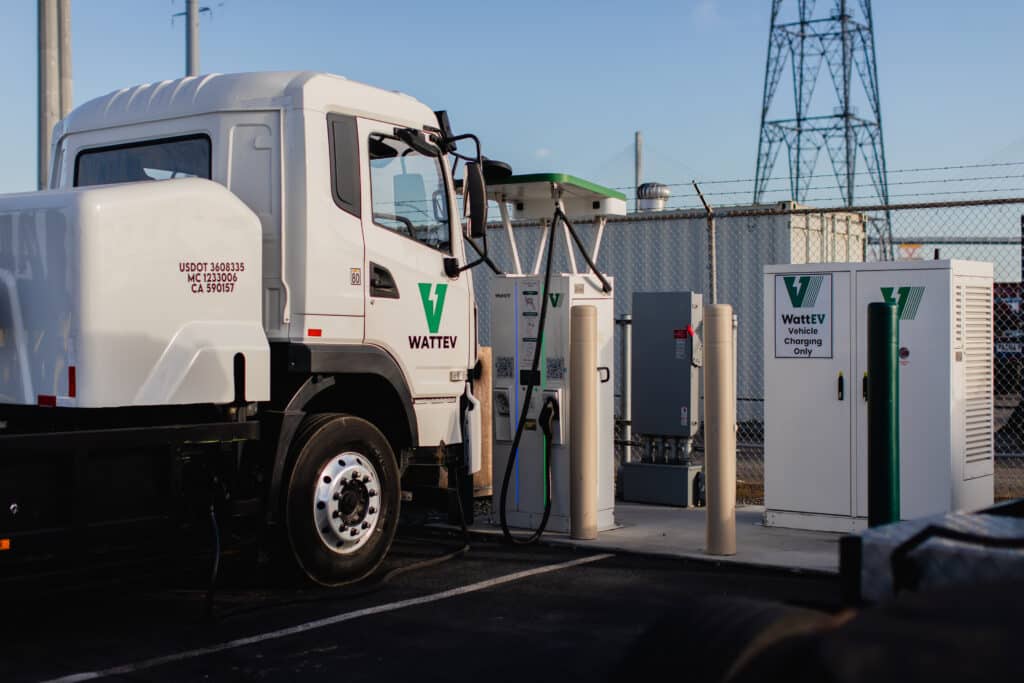
Charging infrastructure providers WattEV and Voltera, meanwhile, are working to expand capabilities across medium- and heavy-duty truck sectors, Miah said. ABB E-mobility also recently launched a megawatt charging system (MCS) solution, according to an April 24 company release.
“MCS is a particularly important thing to take note of for heavy-duty fleets,” Miah said. “It’s a faster charging system that is needed to enable longer-haul heavy-duty trucks.”



Proud Member Of

Check Out Our Industry Event