Equipment buyers delay purchases as economic uncertainty continues
New orders for core capital goods down 1.1% MoM

Equipment demand remains healthy across much of the industry, but economic uncertainty has customers delaying purchase decisions and rethinking financing strategies.
Contractors and fleet operators continue buying equipment, but caution tied to tariffs, fuel prices, interest rates and project pipelines is slowing decision-making, Skip Owen, director of sales at Columbia, S.C.-based Hills Machinery, said during a May 18 panel discussion at Equipment Finance Connect in Houston.
“I think the pie is there,” he said. “It’s a big pie, but it’s shifting.”
Customers are approaching purchases more cautiously than during the post-pandemic equipment boom, with some buyers choosing rental-purchase structures instead of committing to ownership while they wait for economic conditions to stabilize, Owen said.
Still, demand in the Southeast remains strong overall, supported by infrastructure spending and large construction projects, he said.
Core capital goods fall 1.1% MoM
Indicative of the trend in delayed purchasing, new orders for nondefense capital goods excluding aircraft or core capital goods — often viewed as a key measure of business investment — fell 1.1% month over month in April after rising 3.9% in March, according to the U.S. Census Bureau’s advance durable goods report, released May 28.
New orders for core capital goods still rose 7.7% year over year.
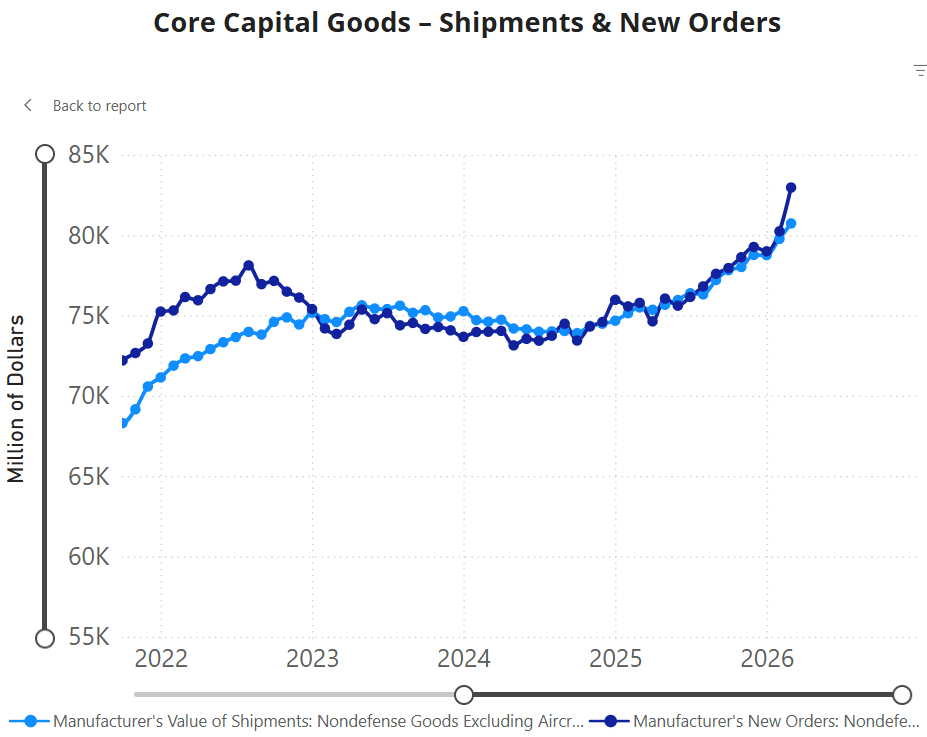
Despite the drop in new orders, core capital goods otherwise showed strength, with shipments up 0.4% MoM in April following a 1.3% increase in March and were up 6.8% YoY, according to the release.
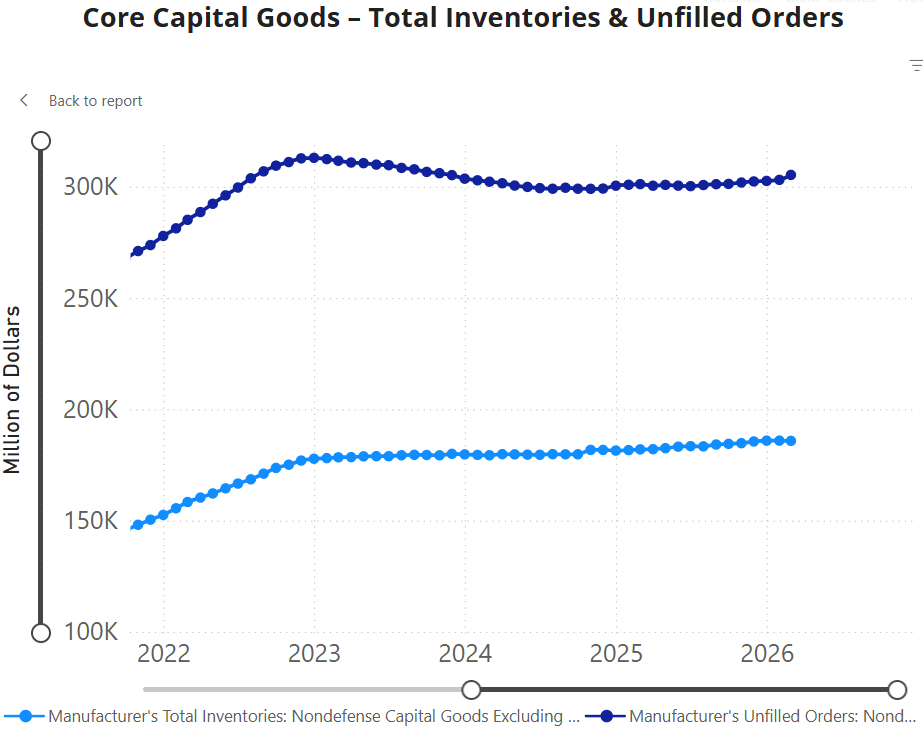
Additionally, unfilled orders for core capital goods rose 0.4% MoM and 2.1% YoY, while inventories increased 0.2% MoM and 2.2% YoY.
Rising costs pressure customers
Rising operating costs also continue to create hesitation among equipment buyers even as financing activity remains relatively healthy, DJ Jackson, senior director of business development at Oakmont Capital Services, said during the panel discussion.
One of the biggest changes is the shortening of project pipelines; during the stronger post-pandemic cycle, many contractors carried months or years of backlog, but that backlog continues to shrink, Jackson noted.
“They went through many years … of just having more work than they could keep up with,” he said.
Businesses facing labor shortages and rising project costs also look to equipment investments to improve efficiency, shorten those project timelines and complete more work with fewer workers, Jackson added.
Meanwhile, the U.S. economy continues to grow, but elevated energy prices and tariff-related inflation pressures are weighing on longer-term CapEx planning, Martin Lavelle, senior business economist at the Federal Reserve Bank of Chicago, said during a presentation at Equipment Finance Connect.
“It’s solid right now, but with not knowing how long the elevated energy pricing environment is going to stick around … that’s caused a little bit of a pullback, especially in longer-term investment thinking, specifically CapEx thinking,” Lavelle said. “The main drivers of growth are consumer spending and a few sectors on fixed business investment, mostly AI-related.”
Check out our exclusive industry data here.

Proud Member Of

Check Out Our Industry Event