Rush, Penske truck sales dive in 2025 amid tight lending climate
Penske F&I revenue declined 19.7% YoY

Truck dealers Rush Enterprises and Penske Automotive saw truck sales slide across the board in 2025 as the freight downturn continued.
The industry grappled with tightened lending standards, stubborn overcapacity issues, low freight rates and economic uncertainty last year, leading to bankruptcies and other signs of distress.
However, OEMs’ heightened focus on aftermarket support and easing overcapacity concerns are contributing to an improved industry outlook for 2026. Increased aftermarket support is crucial because minimizing downtime is key to the market’s potential recovery.
Rush F&I revenue dips 3.9%
San Antonio-based Rush Enterprises reported $21.1 million in finance and insurance (F&I) revenue in 2025, down 3.9% year over year, according to the company’s Feb. 17 fourth-quarter earnings release.
Rush’s aftermarket parts and service revenue rose 0.3% YoY to $2.5 billion, while total revenue declined 4.7% YoY to $7.4 billion. Its total floorplan notes payable landed at $918 million, down 15.1% YoY.
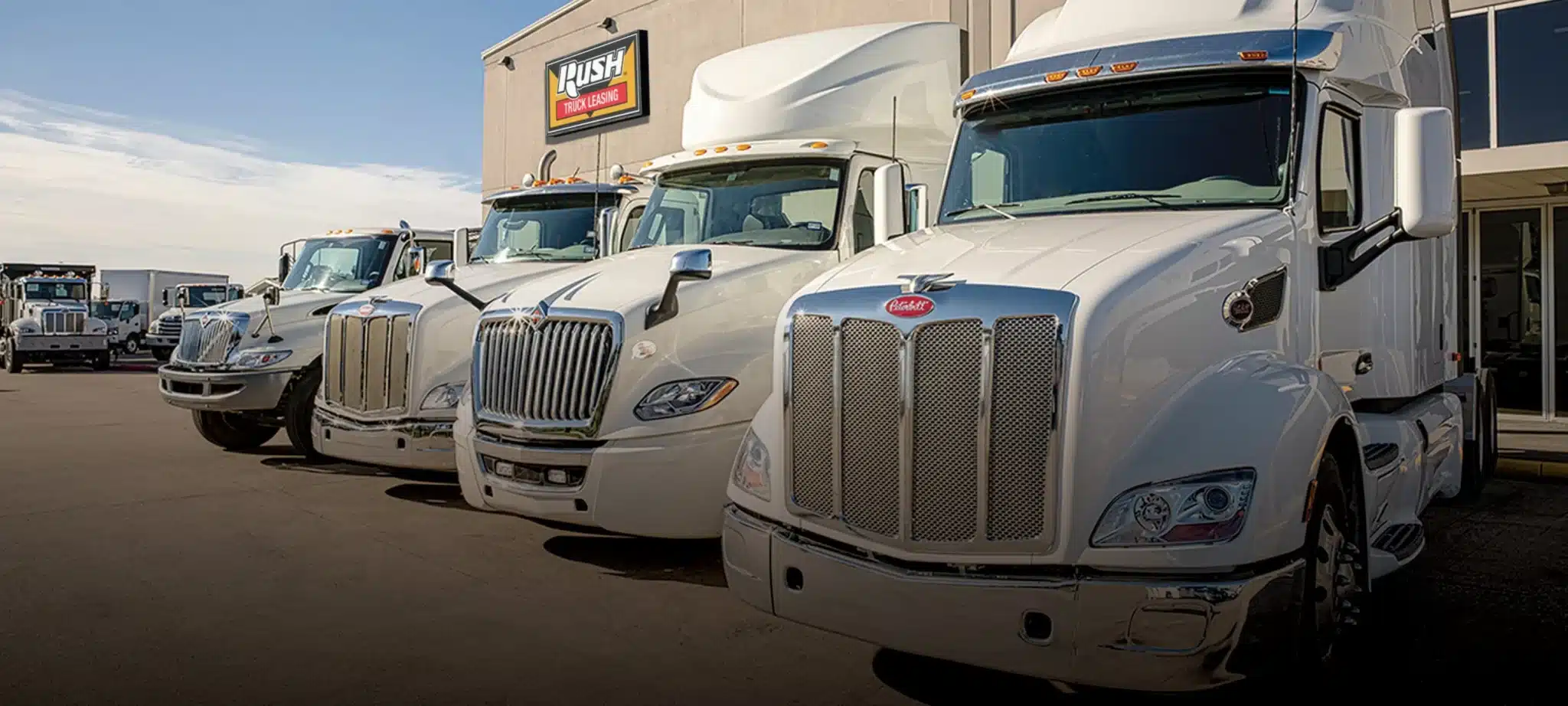
The company’s aftermarket performance reflects the segment’s “resiliency and importance to our overall performance in 2025,” Chairman and Chief Executive W.M. “Rusty” Rush stated in the release.
“As fleet utilization improves and customers address deferred maintenance and aging equipment, we believe demand for parts and service will strengthen,” he said. “Given our recent investments in certain strategic initiatives focused on mobile service, planned maintenance programs and operational efficiency, we believe our aftermarket business is well positioned to benefit as market conditions improve.”
Meanwhile, Rush’s new Class 8 truck sales dropped 17% YoY to 12,432 units, while new Class 4 to Class 7 sales fell 8.5% YoY to 12,285. Used-truck sales dipped 1.9% YoY to 6,977.
The new-truck sales decline came as over-the-road carriers continued to deal with depressed freight rates, excess capacity and uncertainty around tariffs and emission regulations, Rush said.
“These factors led many large fleets to continue to delay vehicle replacement decisions,” he said.
The drop in used-truck sales was largely attributed to a challenging financing environment, although stabilizing used-truck prices present a silver lining, Rush said.
Penske truck sales fall 11.2%
Bloomfield Hills, Mich.-based Penske reported $15.1 million in F&I revenue for its commercial truck segment in 2025, down 19.7% YoY, according to its Feb. 11 earnings release.
Other full-year results for its commercial truck segment included:
- Aftermarket parts and service revenue rose 0.7% YoY to $892.4 million;
- Total revenue fell 3.1% YoY to $3.4 billion;
- New-truck sales dropped 10.9% YoY to 14,580 units; and
- Used-truck sales declined 12.4% YoY to 3,148 units.
Total floorplan notes payable, spanning all segments, ticked up 0.3% YoY to $4.1 billion.
Penske attributed lower truck sales to the prolonged freight recession, but the dealer is hopeful that the “long-awaited recovery” is on the horizon, Chairman and CEO Roger Penske said during its Q4 earnings call.
“The Big Beautiful Bill, tax refunds, lower interest rates and GDP growth will have a positive impact on all of our operations,” he said.
President Donald Trump’s push for increased domestic manufacturing could be “a big driver of freight as well,” Richard Shearing, chief operating officer of North America for Penske, said during the call.
“I think when those dollars start to get deployed and the construction begins relative to those investments, it’s really going to be beneficial for the trucking market,” he said.
Check out our exclusive industry data here.




Proud Member Of

Check Out Our Industry Event