Truck fleets stick to replacement cycles despite diesel price volatility
Diesel prices up 55% YoY

Rising diesel prices and economic uncertainty are causing some trucking fleets to delay equipment purchases, but operators that abandon disciplined truck replacement cycles often increase their long-term operating costs, industry leaders say.
Higher fuel costs, elevated truck prices and several years of weak freight-market conditions have pressured fleet profitability and complicated equipment investment decisions, Reid Farmer, vice president of fleet sales at The Pete Store, told Equipment Finance News.
“It’s very easy for them to pull back and just go, ‘Hey, I’m going to wait,'” he said. “The issue is that usually there’s a cost to waiting as well.”
Freight rates improve as diesel costs remain elevated
To Farmer’s point, the operating environment remains volatile.
The U.S. average on-highway diesel price was $5.350 per gallon on June 1, down 3.1% week over week, but up 55% year over year, according to the U.S. Energy Information Administration.
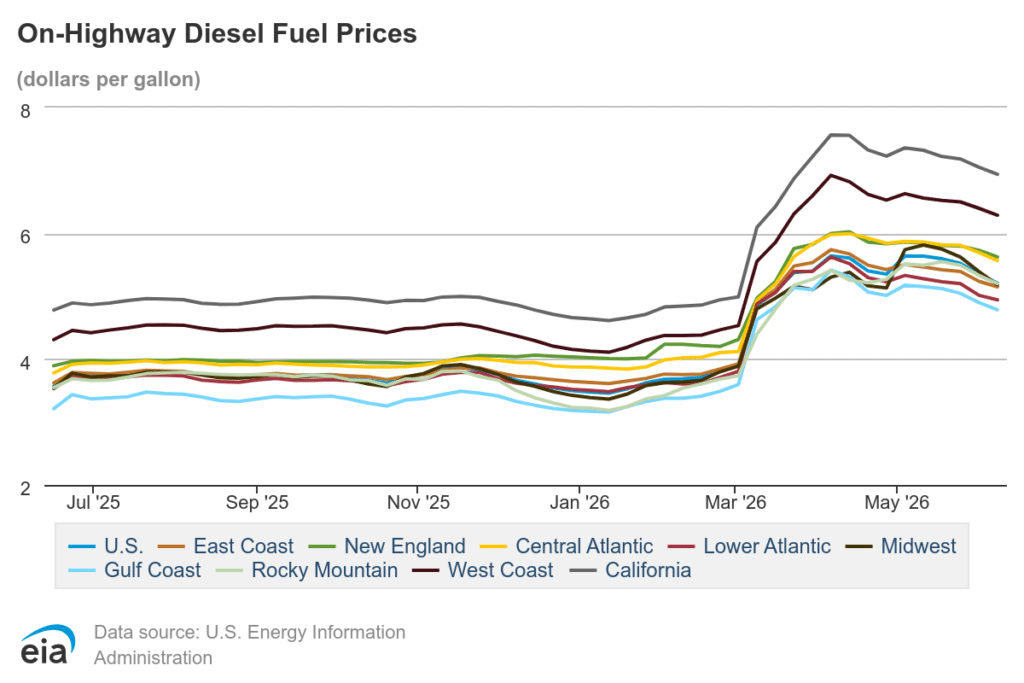
Rising fuel costs remain a concern across transportation and equipment as energy prices continue to be a key variable affecting business planning, Martin Lavelle, senior business economist at the Federal Reserve Bank of Chicago, said during Equipment Finance Connect 2026 last month.
“Higher diesel prices are impacting everybody,” he said. “That’s one thing we’re really keeping an eye on.”
Still, freight-market fundamentals have improved after months of bankruptcies, with Farmer noting that freight rates have strengthened during the past six months as excess trucking capacity exits the market and shippers become more willing to accept fuel surcharges.
Government data supports that trend, with the Producer Price Index for long-distance truckload freight transportation having increased by 10.9% month over month and 20% YoY in April, according to Bureau of Labor Statistics data.
“For the past two years, if you went to your customer and raised the rate, they would just go to somebody else because there were so many trucks on the road and the rates were not good,” Farmer said.
“The world that’s receiving the stuff from these trucks is more accepting of a fuel surcharge these days.”
Delaying truck purchases can increase costs
While fleet owners might postpone truck purchases to preserve cash flow, extending equipment life often leads to higher maintenance expenses, more downtime and declining residual values, Farmer said.
“The smartest ones are figuring out that … it’s always going to be something. How do we navigate whether it’s a good environment or bad environment and stick to our cycle of replacement?” — Reid Farmer, vice president of fleet sales at The Pete Store
Successful fleet owners increasingly evaluate equipment decisions through a total-cost-of-ownership framework rather than focusing solely on repair bills or monthly payments, Farmer said.
“The proactive approach is a bigger picture of fuel consumption, maintenance spending, downtime, driver productivity and residual value,” he said.
Data-driven maintenance
Meanwhile, technology also is helping fleet owners manage operating costs through telematics, predictive maintenance tools and preventive maintenance programs that identify issues before they result in costly breakdowns, Farmer said.
Fleet owners should prioritize operational efficiency, maintenance discipline and data-driven decision-making rather than attempting to time fuel markets, Farmer noted.
“The goal is not simply … how can we save a buck today,” he said. “It’s to operate more efficiently and profitably over the life cycle and total cost of ownership of that fleet.”
Check out our exclusive industry data here.



Proud Member Of

Check Out Our Industry Event