Surge pricing and midnight discounts: EV charging rates go dynamic
Rates have changed for nearly 40% of public fast-charging stations

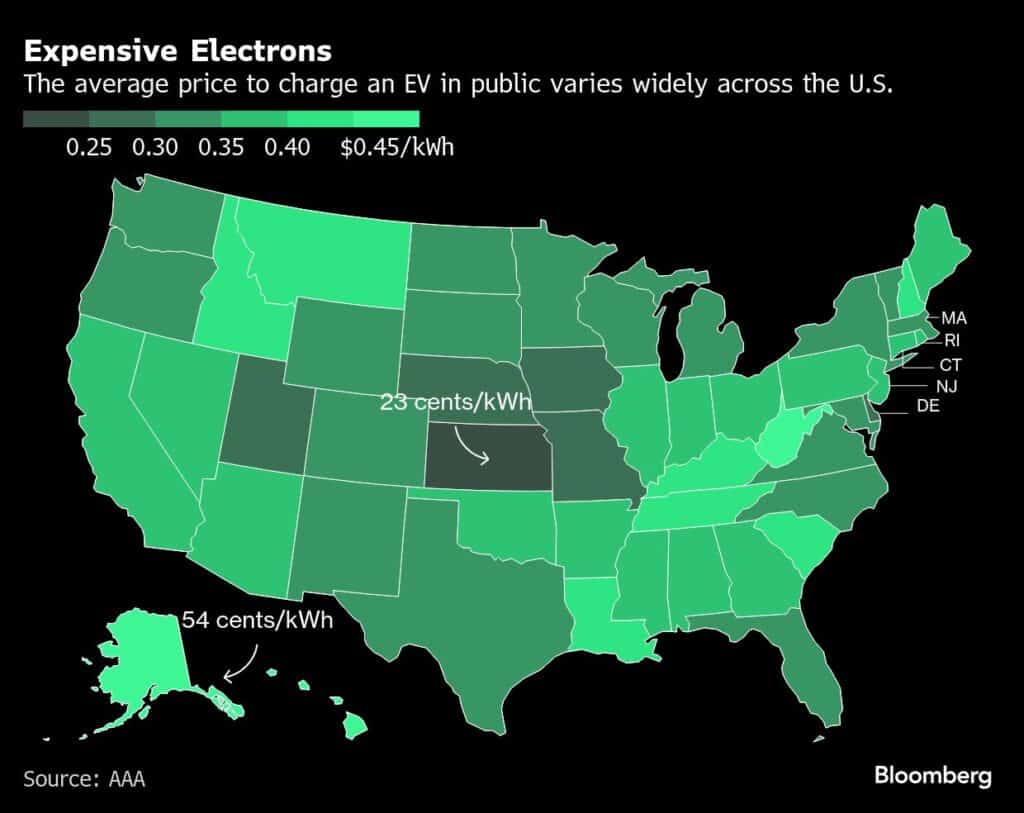
When Jeffrey Raun drives his Tesla Model 3 far from his Anchorage home he pays some of the highest public charging rates in the nation. Juicing the car’s battery from 10% to 90% full costs somewhere around $32 at the Three Bears grocery and sporting goods outpost in Chugiak, roughly triple what he pays at home.
“This is a choice we’ve made and we’re all in and we’re going to charge where and when we need to charge,” Raun explained. “I firmly believe I’m still money ahead in the use of my EV.”
Soon, however, Raun and other EV drivers may see prices swing dramatically higher (and occasionally lower) as fast-charging networks roll out dynamic pricing. Nearly 40% of the country’s 10,700 or so public fast-charging stations recently started adjusting rates often and aggressively, based on a myriad of factors that skew the supply-demand equation, from weather and events to holiday travel spikes and fluctuating electricity rates.
For charging companies, the strategy is arguably a no-brainer — a page from the gas station playbook that analysts say will help long-struggling networks finally plug into fatter profits. There are benefits for consumers as well. Shifting prices will mitigate congestion by spreading demand throughout the day and giving price-sensitive drivers — particularly Uber and Lyft workers — windows of steeply discounted rates, typically in the wee hours of the morning.
However, the strategy will make public charging, one of the biggest barriers to EV adoption, even more confusing and opaque.
$35 or $48?
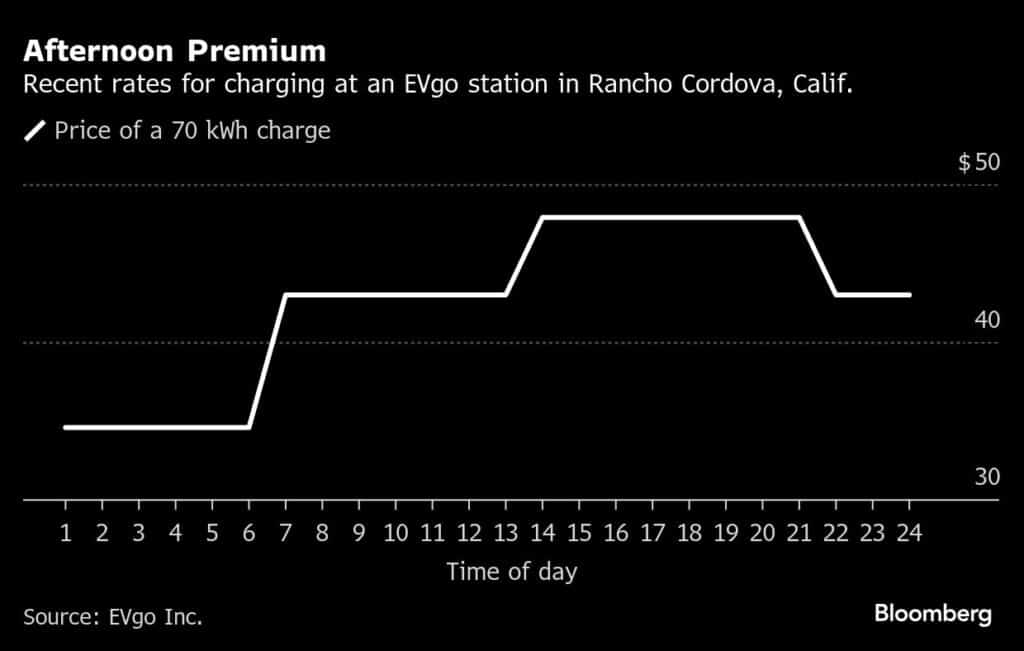
Consider a driver plugging into the EVgo Inc. station outside the Denny’s in Rancho Cordova, California. If she is a night owl topping up between midnight and 6 a.m., 70 kWh of charging costs about $35. However, from 1 p.m. to 9 p.m., that same session will run about $48, nearly 38% more, according to EVgo’s pricing a few days ago.
While much of the industry has hesitated to tinker with prices, EVgo, which operates about 1,100 fast-charging stations in the US, says algorithms are now constantly tweaking prices throughout its network.
EVgo declined a request for comment. But in its recent earnings report, the company said its dynamic pricing has pushed overnight utilization at its stations into double-digit figures on average. The company, in short, is now doing business at times when it used to do little, which is making its cords less crowded during peak periods.
“We’re looking to maximize margin,” CEO Badar Khan explained on a conference call. “We’re not talking about something being reinvented here. We’re taking, kind of, concepts that have been very successfully executed in other parts of the economy into the space.”
Chris Pierce, an analyst covering charging networks at the Needham & Co. Inc. investment bank, considers EVgo’s new pricing strategy a major competitive advantage. “There’s no doubt it’s working,” he explained. “And I don’t think this train is stopping anytime soon. … You have a bunch of EVs on the road and not enough infrastructure in the ground.”
Tesla Inc., which did not respond to requests for comment, has a similar pricing program for its 2,500 or so US fast-charging stations. The rest of the charging industry isn’t far behind. Driivz, a Raleigh, North Carolina-based software and analytics company that serves 150,000 chargers around the world, promises its dynamic pricing models can increase revenue by up to 20%.
“It’s becoming a very hot topic,” explained Oren Halevi, Driivz’s chief product officer. “It’s just a really good way for networks to make money.”
Stable Auto, a consultancy that helps charging companies decide where to put stations, started pitching dynamic pricing about a year ago. It’s now actively shifting rates at some 5,000 US chargers, including many operated by Blink Charging Co. and EV Connect Inc.
Stable CEO Rohan Puri said he talks to lots of charging executives who are intrigued by dynamic pricing but hesitant to embrace it. They are concerned about further confusing customers, being accused of price gouging and possibly slowing EV adoption.
“There’s been this pressure to make sure EV charging is cheaper than gas,” Puri explained. “It’s an ethical pressure … but most [networks] are not making money, so we have to pull whatever levers we have.”
What’s a kilowatt-hour?
Public charging has long been one of the most frustrating parts of EV ownership and opaque pricing is a big reason why. In a recent J.D. Power survey, EV drivers gave fast-charging costs a satisfaction score of 429 out of 1,000.
Charging rates — even when they aren’t being whipsawed by dynamic pricing algorithms — are plenty confusing. They vary by network, by state and by station and though most locations charge by the kilowatt-hour, some still charge by the minute. What’s more, unlike gas station pumps, charging stations don’t prominently display their rates, and often tack on extra fees and surcharges.
And then there’s the question of how drivers find stations. Half of EV drivers use three or more apps to choose chargers, but many of those apps don’t display real-time prices, according to a recent study by the state of California.
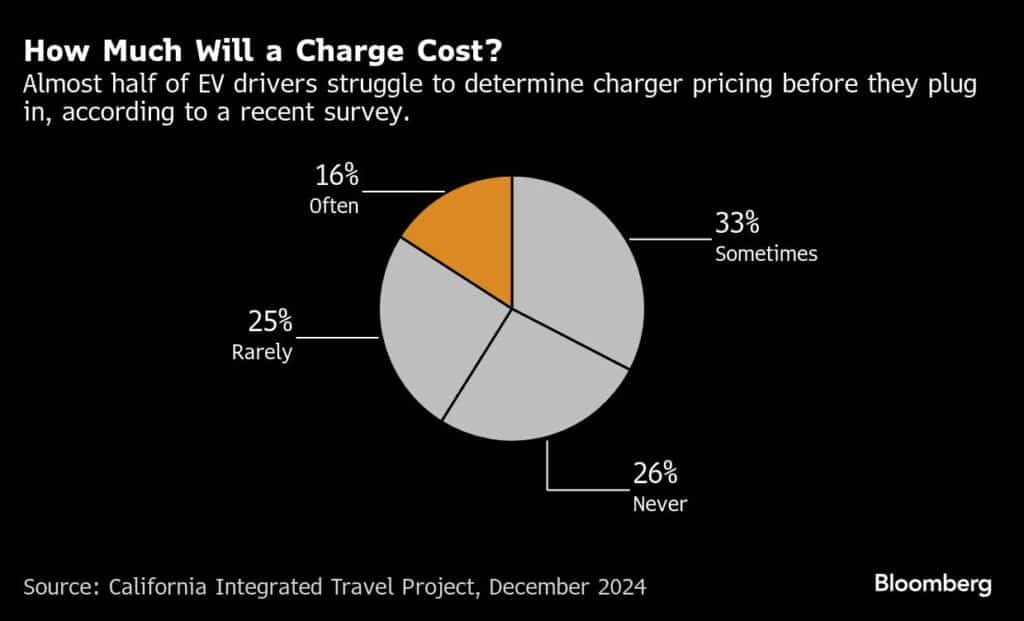
State regulators found that almost half of EV drivers considered it difficult or very difficult to find information about charging costs in advance of a fueling session and nearly 40% said they paid surprise fees or a significantly higher price for charging than expected.
“Customer confusion and surprise around EV charging prices is a significant challenge nationwide,” the report reads. “This especially impacts low-income or disadvantaged drivers, who rely more on public chargers, have less access to digital payments, have tighter budgets, and may struggle to understand information presented in inaccessible ways.”
Dynamic pricing will exacerbate this frustration to some degree. Consumers have come to expect that prices are on a pendulum that never stops swinging, from airline and concert tickets to gasoline. Still, they tend to bristle at dynamic pricing. Almost one in four Americans say they won’t spend money at a business that uses it, according to a recent NerdWallet survey.
Choose-Your-Own Charging Adventure
If gasoline is any gauge, EV pricing will only get more complex. Not only will networks shift prices through the day, but the people tinkering with the algorithms say drivers will pay big premiums at stations hit by a charging rush, say outside an NFL stadium on game day or on a busy travel corridor Thanksgiving week.
Puri at Stable thinks drivers will eventually choose their own pricing. For example, those in a rush may soon be able to select a faster, more expensive charge, while those on a budget or a relaxed schedule can opt for slower, cheaper service at the same electron pump — essentially the line-cutting model that has become ubiquitous at amusement parks.
“We do it at Disneyland,” he said, “why not at a charger?”



Proud Member Of

Check Out Our Industry Event