New York has enacted the 2022 amendments to the Uniform Commercial Code, updating state law to address digital assets and emerging technologies.
Gov. Kathy Hochul (D) signed the bill into law on Dec. 5, according to the Uniform Law Commission‘s website. New York became the 33rd jurisdiction to adopt its version of the revised Uniform Commercial Code (UCC) framework, including California and Florida.
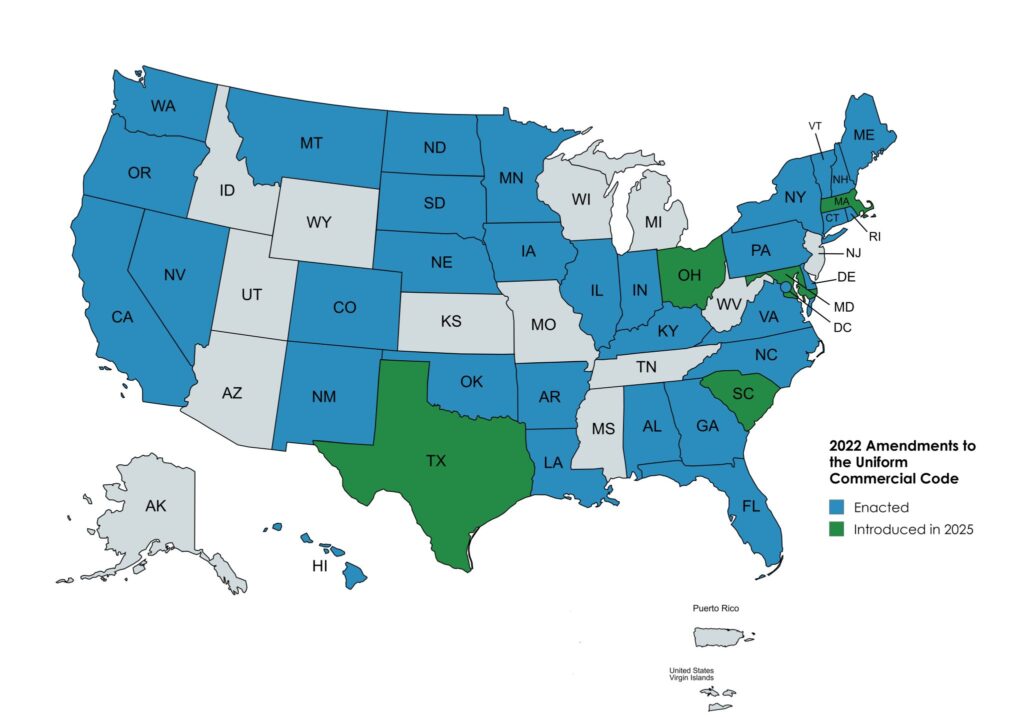
Under the 2022 UCC amendments, equipment finance and other commercial finance transactions face new regulations related to digital assets as well as updated regulations regarding digital transaction records and hybrid leases. New York represented one of the largest jurisdictions to not adopt the amendments before the governor’s signature.
The law, which takes effect June 3, 2026, incorporates the Article 12 amendment governing commercial digital property rights, Barbara Goodstein, partner at Chicago-based financial services law firm Mayer Brown, during the 2025 Equipment Leasing and Finance Association Convention. The 2022 amendments also allow lenders to perfect security interests through control, similar to chattel paper, when a single holder has exclusive authority to control, transfer and use the asset.
“It creates a legal regime for the transfer of either a title or creating collateral digital assets and allows purchasers to acquire the assets free and clear of claims,” she said. “It creates this new concept called the controllable electronic record, the CER.”
In addition, the New York version of the bill includes key updates to Article 9 on secured transactions related to collateral, according to the New York State Assembly’s website. The revisions reflect broader efforts to make the state’s commercial law technology-neutral, while accommodating innovations and clarifying how digital assets are treated.
Long-term New York UCC outlook
The New York law also includes an “adjustment date” of June 3, 2027, or one year after the effective date, for any changes that need to be made.
Timing represents a critical element for UCC filings, since they expire after five years in most cases, Suzie Neff, consultant for collateral-based lending and an industry relations lead for Wolters Kluwer Lien Solutions, told EFN.
“At the end of five years, if you take no action, that UCC is going to expire on its own terms,” she said. “We’ve seen situations where legal counsel for the borrower gets all up in arms because the UCCs weren’t released in a timely fashion.”
Check out our exclusive industry data here.




Proud Member Of

Check Out Our Industry Event