Trump courts farmers with $8 billion fuel aid during harvest
Shares of Deere, AGCO rose today

The Trump administration announced $8 billion in aid for farmers to help offset rising fuel costs, a major burden for growers during the harvest.
The move is the administration’s latest attempt to ease financial burdens on growers — traditionally a strong Republican voting base — ahead of midterm elections. The White House earlier this month also eased limits restricting the use of a tax-exempt variety of diesel.
The Harvest Fuel Relief program will “provide relief during temporary market disruptions and increased input costs,” the US Department of Agriculture said in a statement late Monday. The one-time payments will cover a portion of modeled losses for farmers during the 2026 crop year, according to the agency.
Diesel prices have surged globally as the US-Iran conflict constrains fuel exports through the Strait of Hormuz. Retail prices in the US hit a record at $6.50 a gallon in September, creating headaches for the president ahead of elections.
The upheaval is further delaying a recovery for farmers already struggling with massive global crop inventories and limited growth in demand. President Donald Trump’s tariff wars have also interrupted American agricultural exports and contributed to higher costs.
Missouri farmer Marty Richardson said most growers aren’t able to turn down aid but would rather see the Strait of Hormuz reopened or for US diesel exports to be temporarily halted.
“I really don’t like taking government aid but the environment we’re in, you can’t really say no because the margins are so small,” Richardson said.
Farmer sentiment, which recently fell to the lowest since January amid pressure from high costs, could quickly improve following the move, according to Oppenheimer analyst Kristen Owen. “While diesel only represents a small portion of the farmer’s expenses, it’s one they feel for immediately and we see that already impacting sentiment,” she said.
Shares for farm-equipment makers Deere & Co., CNH Industrial NV and AGCO Corp. rose on Tuesday.
Garrett Love, who raises sorghum, wheat, corn and other crops in Kansas and is chairman of the National Sorghum Producers, said the assistance will provide needed support to finish up harvest and prepare for next year’s growing season. The National Corn Growers Association and National Association of Wheat Growers also welcomed it.
“Sorghum farmers are facing tight margins, and higher diesel costs put even more pressure on our ability to bring a crop to market,” Love said in a statement.
The US sorghum harvest was 46% done as of Sunday while the corn harvest was 44% complete and soybeans 64% done, according to the USDA.
Trump, at a Monday rally in Kansas, touted the new USDA program, while calling his earlier executive order on so-called red-dyed diesel “a big deal.”
“But even without that, as soon as that war ends, you’re going to see a plunge because there’s so much oil and diesel around,” he said.
In response to soaring diesel prices, Trump has turned to Russia to increase diesel supply, putting him in conflict with US allies and some in his own party.
Farmers have been paying up for fuel and also waiting for China to start buying more, with crop prices under pressure as the flood of incoming supplies has outpaced demand for them. Soy and corn futures each slumped to the lowest levels since August in Chicago on Tuesday.
Exporters have sold more than 2 million tons of US soybeans to China so far in October, with a deal announced Tuesday of 612,000 tons, the second-largest purchase of the year. But sales of other US goods have been slower, and shipments of grains such as sorghum and corn as well as cotton and meat will be needed for China to meet a goal outlined by the White House for $17 billion in prorated annual agriculture purchases.
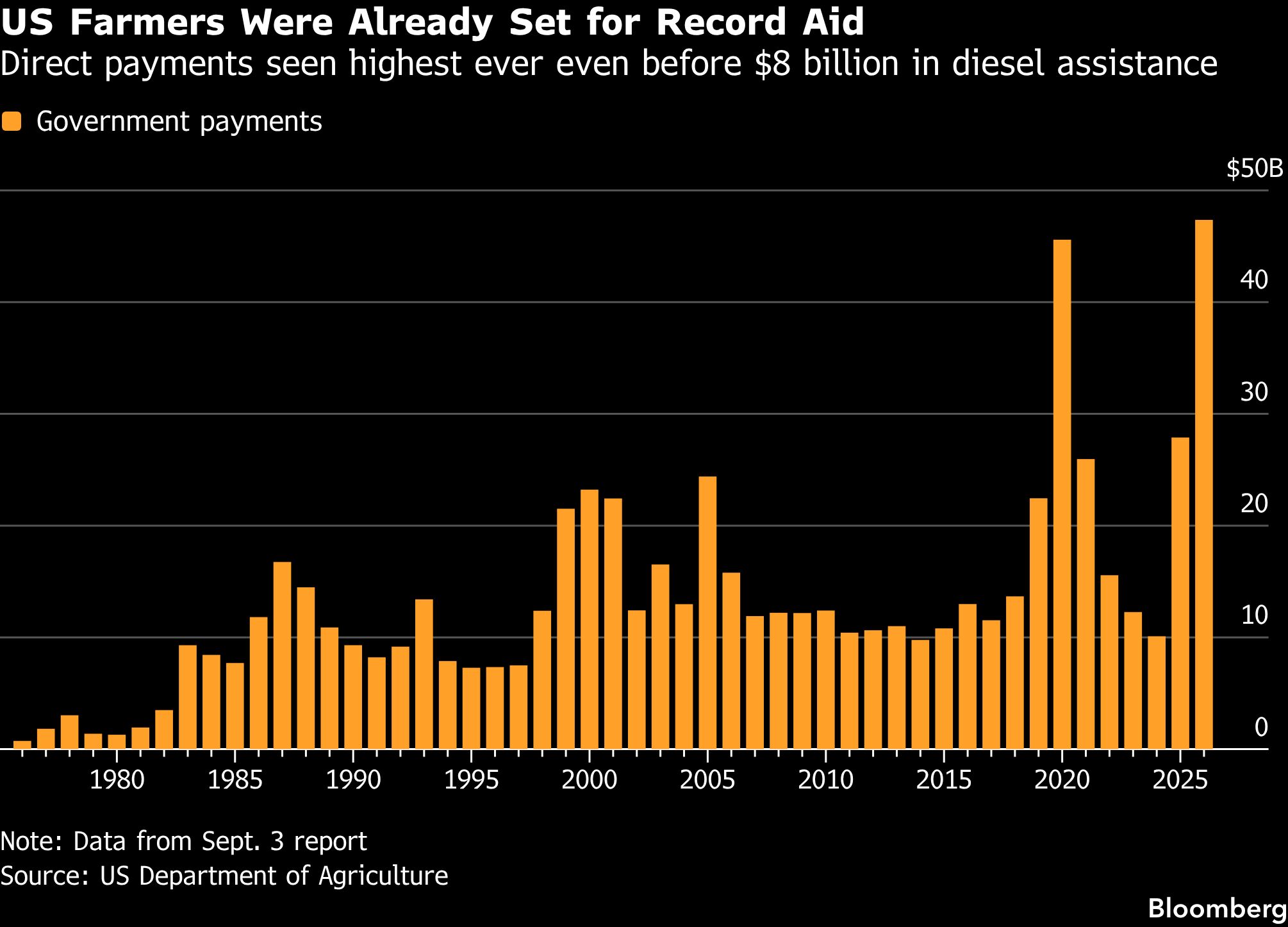
The latest round of aid follows a June proposal by the Trump administration for $11.1 billion in new farm assistance, after a previous $12 billion rescue package that started paying out earlier in the year.
The new aid payments will be based on planted acres, as well as estimates of production costs and forecasts of yields and prices provided by the USDA. Specific payment rates for each crop will be released next month.


Proud Member Of

Check Out Our Industry Event