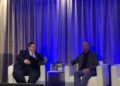
John Deere Financial’s new president eyes usage-based financing
JDF’s net income improved 6.1% YoY in Q1

John Deere Financial is exploring usage-based financing models as its new president coaxes the captive to evolve beyond traditional equipment lending.

Jerred Pauwels, who assumed the role on Feb. 2, plans to add financing models that align payments with equipment usage, performance and customer outcomes, he told Equipment Finance News.
“Our goal at Deere is not just to provide a tractor and to just provide a loan to finance the tractor, but it’s to help make that customer more productive and more profitable,” he said. “JDF plays a pretty critical role in partnering with our equipment division colleagues in the business and financial side of that customer being more profitable.”
Financing models under consideration at the captive include:
- Cost-per-hour equipment financing tied to machine use;
- Subscription-based financing for precision agriculture equipment and software; and
- Outcome-based financing linked to machine productivity or crop yield.
Financing based on the outcomes the equipment helps achieve or results a machine achieves directly represent key models to the future of equipment-as-a-service (EaaS), Ann Brodette, senior vice president and general manager of industrial, Mitsubishi HC Capital America, previously told Equipment Finance News.
Outcome-based financing, which is still in development at JDF, as well as cost-per-hour and subscription-based financing, reflect the wider industry trend in equipment finance of EaaS as customers seek more predictable costs and flexible payment structures, Pauwels said.
“Customers want predictability in their economics and their expenses.” — Jerred Pauwels, President, John Deere Financial
The shift comes as Deere expects large agricultural equipment demand in the United States and Canada to decline 15% to 20% year over year in fiscal 2026, according to its Feb. 19 earnings release for its fiscal 2026 first quarter. In Q1, JDF reported net income of $244 million, up 6.1% YoY, while operating profit increased 13.2% YoY to $301 million, driven by improved financing spreads and lower credit costs.
Shifting finance strategy
For OEMs, the shift toward subscription and outcome-based models provides more consistency for everyone and aligns payments with customer revenue while requiring new systems to support ongoing, direct customer transactions, Pauwels said.
“When you go to a subscription model, some of that’s going to come direct, so we’re providing some of that enabling capability to the organization to help support subscription business models,” he said. “When you put the [JDF] piece together with the operational side equipment, we think we can be a compelling partner to help them do that.”
A move toward outcome-based financing also signals a change in the equipment finance industry, particularly among captives.
Rather than only focusing on loans and leases, captives are becoming strategic partners and tools for OEMs, Kirk Mann, executive vice president and general manager of transportation and vendor solutions at Mitsubishi HC Capital America, previously told Equipment Finance News.
For Pauwels, a third-generation Deere employee with nearly 19 years at the company, success in his first year as president would mean more customers choosing the captive as their preferred financial partner, while the company continues improving its technology to better support them, he said.
“If we can win over more customers so that their first choice as a financial partner is John Deere Financial, that would be a success,” Pauwels said.
The fourth annual Equipment Finance Connect, a crucial industry event for equipment lenders and dealers, takes place at the C. Baldwin Hotel in Houston May 18-19. Learn more about the event and register here by April 3 for early-bird savings.


Proud Member Of

Check Out Our Industry Event