Wind energy market drives crane financing
North American offshore crane market could reach $2.3B by 2034

Growing demand for wind energy is igniting crane finance activity across the globe, with OEMs, dealers and rental companies all standing to benefit.
The global wind energy market is projected to more than triple to $361.2 billion by 2035 from $115.3 billion in 2024, according to research and consulting firm Roots Analysis. Wind power generation in the United States has increased 34% over the past four years, according to the U.S. Energy Information Administration.
Meanwhile, the North American offshore crane market is expected to hit $2.3 billion by 2034, nearly double from 2024, largely driven by wind power production, according to Global Market Insights.
Equipment lenders are capitalizing on growing demand for cranes to support installation and maintenance of wind turbines, Bas Bennebroek, chief financial officer of Dutch lender Beequip Equipment Finance, told Equipment Finance News. Beequip expanded into North America four years ago, he said.
“We see strong demands coming from the wind industry here in Europe, but also from the States, which is driving demand for larger and larger cranes not only for new projects but also for maintenance of existing projects,” he said. “Just the installed fleets of wind turbines are growing every day, and those need to be maintained. You need very large cranes for that.”
Beequip identifies crane finance as one of the strongest segments in North America, Bennebroek said, noting that its expertise in this asset class can “differentiate” Beequip from other lenders.
Specialized solutions
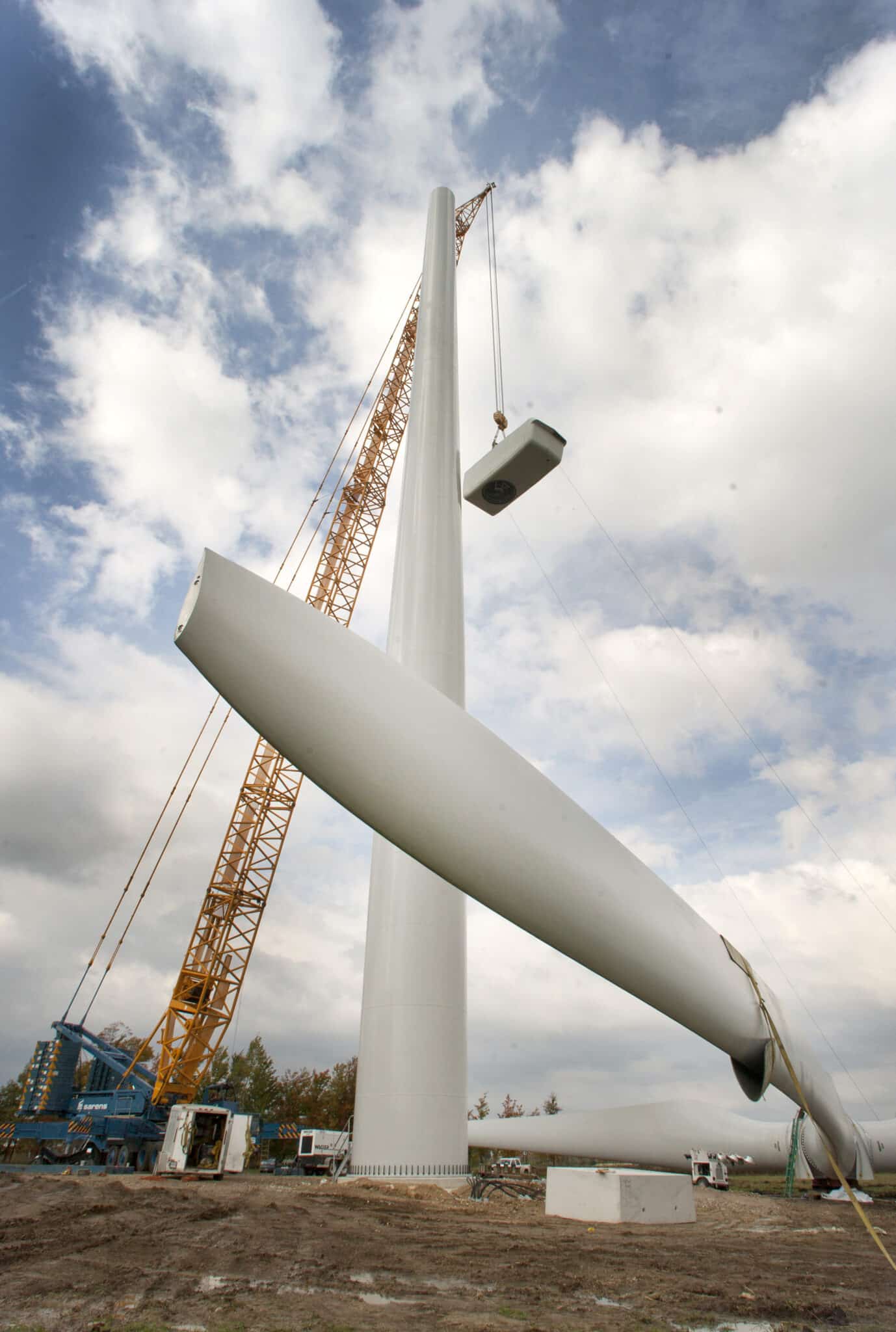
The tallest onshore wind turbines stand higher than 650 feet, and offshore turbines can range close to 1,000 feet, or about three-fourths the height of the Empire State Building, according to online crane marketplace MyCrane. These mammoth structures require specialized equipment including:
- Ultra-high-capacity crawler cranes that can lift up to 600 tons of nacelles — the housing at the top of a turbine that encloses the main power generator components;
- Tower cranes for the installation of blades that often exceed 250 feet in length; and
- Custom rigging systems that accommodate awkward dimensions and allow precise control during lifts.
OEMs are responding to growing demand for specialized solutions. Lift and material handling equipment manufacturer Palfinger Marine, for example, recently partnered with sustainable energy company Vestas to provide specialized nacelle cranes for servicing offshore wind turbines, according to a Sept. 10 company release.
“This cooperation allows us to further develop our products and to customize them to the specific demands for turbine maintenance,” Iavor Markov, global key account and segment manager at Palfinger Marine, stated in the release. “Our customers can benefit from our service in the long term.”
Notably, parent company Palfinger recently launched a captive financing arm, Palfinger Financial Services, listing “ongoing service support” as one of its offerings in an Oct. 27 release.
Crane OEMs including Liebherr and Manitowoc have also partnered with energy companies in recent years to support development and maintenance of wind turbines. Both companies make cranes that can extend higher than 650 feet.
Rent versus buy
The crane rental market is projected to more than double to $43.1 billion by 2034 from $19.8 billion in 2025, according to Global Market Insights.

Crane rentals may be more feasible than purchasing for many customers due to significant upfront costs, transport costs, insurance premiums and maintenance expenses, according to a MyCrane blog post, noting that renting transfers risk to the rental provider while helping businesses preserve capital.
In addition, crawler cranes are among the most expensive in the construction industry, ranging from about $1 million to $5 million, according to a blog post by equipment dealership Power Screening.
While renting makes financial sense for some customers, high rental fees make traditional financing more conducive to businesses using cranes regularly, Paul Fogle, managing director at Carmel, Ind.-based Quality Equipment Finance, told EFN.
“Renting a crane can cost thousands of dollars per day,” he said.
Register here for the free Equipment Finance News webinar “Tech-driven risk management: How innovation is reshaping equipment finance” set for Tuesday, Dec. 9, at 11 a.m. ET.



Proud Member Of

Check Out Our Industry Event