Workhorse CEO Scott Griffith on financing strategy, EV truck outlook
Company’s revenue soared 201% in 2025

Commercial EV manufacturer Workhorse is sharpening its financing model as it looks to address residual value uncertainty and affordability concerns.
The EV truck maker believes flexible financing and a heightened focus on battery maintenance are among the keys to navigating unpredictable depreciation curves and limited resale data, Chief Executive Scott Griffith told Equipment Finance News.
Reflecting this focus, Workhorse has partnered with InCharge Energy, a provider of EV charging products and services for commercial fleets, according to a Workhorse release today. The partnership will create a “one stop shop” for charging solutions for Workhorse customers, the release states.
InCharge’s products include software that supports battery management and maintenance by providing real-time monitoring, diagnostics and troubleshooting, according to the company.
Despite market challenges, Workhorse saw revenue surge 201% year over year to $21.2 million in 2025, according to its March 31 earnings release. In December, Workhorse completed its merger with Motiv Electric — where Griffith was previously CEO — leading to $50 million in new debt financing capacity and simplifying its capital structure, the release states.
Griffith, who became CEO after the merger, recently shared his thoughts on financing, aftermarket support and the commercial EV outlook with EFN. What follows is an edited version of the conversation.
Equipment Finance News: What are the keys to navigating residual value uncertainty when financing EV trucks?
Scott Griffith: Any new asset needs ”real world data” to de-risk the residual value question. With 1,100 trucks and 20 million miles under foot, we’re well positioned as a market leader to have data-driven answers.
On top of that, we operate a fleet as a FedEx contractor and we’re gathering a full data set from that source too. So, the trick isn’t trying to nail the residual; it’s building financing that can handle a range of outcomes. A few things we keep coming back to:
- Keep lease terms on the shorter side. The technology is still moving fast, and you don’t want to be stuck holding a truck that’s been leapfrogged;
- Lean on the OEM. Residual guarantees and transferable battery warranties go a long way, and if a manufacturer won’t stand behind their own truck, that’s worth paying attention to;
- Pay attention to the battery, not just the truck. How it’s been driven and charged matters more than the miles on it;
- Don’t assume today’s incentives will be there in five years. A lot of the math right now leans on tax credits and charging buildout that could look very different down the road.
EFN: How would you define Workhorse’s financing strategy?
SG: Workhorse’s financing strategy is built around flexibility and meeting customers where they are. We’ve partnered with multiple lending sources to offer a full spectrum of options — from traditional purchase financing for fleets that want to own the asset outright, to operating leases for those who’d rather keep the trucks off the balance sheet and preserve capital.
For customers who want to go electric without taking on the operational or residual-value risk, Workhorse has strategic partners that offer turnkey, end-to-end electrification programs that bundle the vehicle, infrastructure and service into a single solution. The goal is simple: Make it easy for any fleet to transition to electric on terms that fit their business, whether that means owning, leasing or handing the whole thing off to us.
EFN: What measures are Workhorse taking to ensure that its dealers provide strong aftermarket support?
SG: As an OEM, we can’t be everywhere at once, but what we can do is partner with dealers that share our values and deliver those same values to our mutual customers. When we partner with a new dealership, we look for those organizations that can not only just support a one-time transaction, but also have the knowledge and invested interest to support whatever questions a new prospect may have, or a current owner may encounter, and can provide a seamless experience for every Workhorse truck owner or operator.
One of the key aspects for us is that we strive to have every Workhorse dealer be a servicing dealer. It’s not enough for a dealer to have a workshop, or even to stock some spare parts. We expect and mandate that servicing dealers be fully trained in the product and how to service it safely and promptly.
Before certifying any dealer or fleet to perform warranty work, we require every technician who touches a vehicle to pass through Workhorse U, a custom-tailored training program developed by our in-house technical training team.
EFN: What kind of strides is the EV truck market making in terms of proving ROI, and how is this influencing fleet operators’ decisions?
SG: Workhorse is unique among OEMs in that a subsidiary of ours, Stables by Workhorse, is an independent service provider contracted with FedEx. Not only do we get real world insights as a fleet manager, but because our fleet is a mix of [internal combustion engine] and EV, we can generate TCO [total cost of ownership] comparisons. We have seen demonstrated 64% lower operating cost per year compared to ICE vehicles. If our numbers are representative, it makes a strong case for overall TCO savings of electric versus ICE.
That said, we know we have to compete on more than TCO. We have to compete on price.
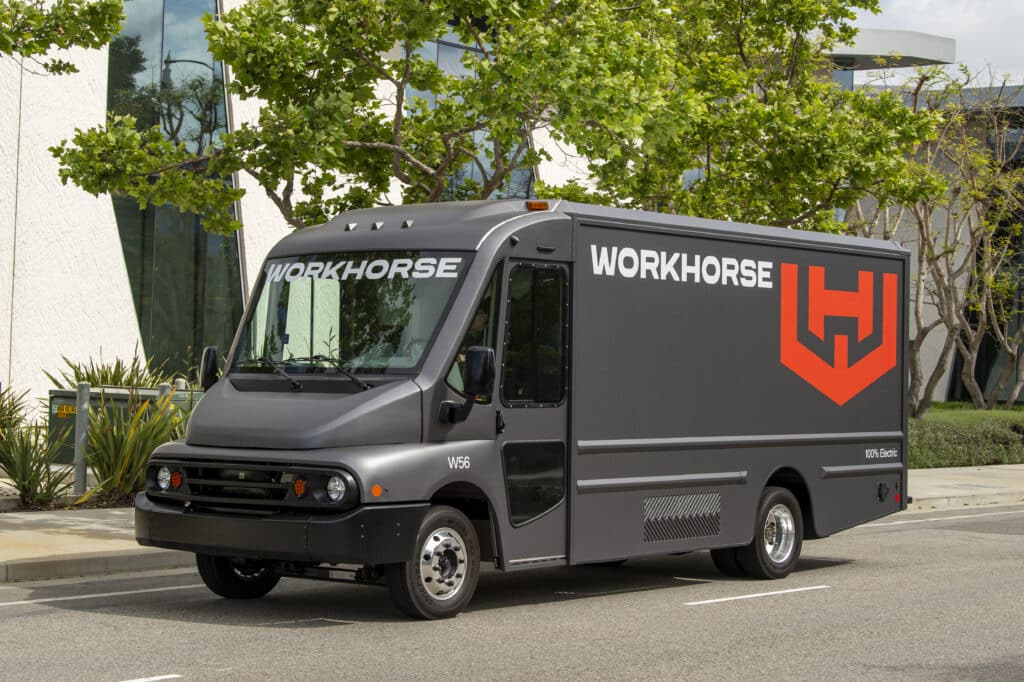
Workhorse has recently made two significant moves to do just that. We’ve introduced a 140-kilowatt version of our popular W56 step van. It comes with a lower price while still offering range and payload that meets the needs of our last-mile delivery customers. We also introduced promotional pricing on our 210-kWh step van. This was enabled in part by some of the early synergy benefits from our merger with Motiv in 2025.
Overall, we’ve embarked on a companywide effort to reduce overall [bill-of-material] costs through the commonization of hardware and software platforms, strategic use of the supply chain and the aggregation of our previously disparate manufacturing locations into our Union City, Indiana, facility.
EFN: How can EV truck stakeholders ease concerns related to surging energy demand? Do you foresee collaboration opportunities with data center companies to strengthen or stabilize grid capacity?
SG: Surging energy demand has not been an issue raised by customers as far as we’ve seen. Most of our customers charge their vehicles overnight at depots, when demand is less. What we do hear from customers is that the cost of energy is relatively stable and predictable, unlike fossil fuels, which are more volatile, especially recently.
We are excited for the day when fleet deployment sizes are large enough to have a meaningful impact to the grid and rising industrial energy demand loads through vehicle-to-grid technologies and other load-leveling or reserve storage capacity. We are working on making sure our vehicles can play a part. The more battery systems we can deliver and deploy, the bigger the potential for these types of secondary uses and collaborations.
EFN: What is your overall outlook for the commercial EV market over the next 12 to 18 months?
Despite the well-documented headwinds facing the industry, we remain optimistic about the months ahead. We just announced a 100-vehicle order with Purolator, a longstanding customer of Motiv’s, and we expect to make additional announcements soon. We continue to see strong interest from last-mile package delivery companies, especially the independent service providers that contract with companies like FedEx. Last, we are having success in meeting the needs of various municipalities for a range of vehicles, from stake beds to shuttle buses to school buses.
The good news for Workhorse is that our models project break even on a cash flow basis when we get to about 2,500 vehicles per year. That’s slightly more than half of the capacity of our existing plant, and represents about 1% of the total number of new Class 4-6 trucks manufactured each year.
The fourth annual Equipment Finance Connect, a crucial industry event for equipment lenders and dealers, takes place at the C. Baldwin Hotel in Houston May 18-19. Learn more about the event and register here.


Proud Member Of

Check Out Our Industry Event