“If we don’t see that progress, then we won’t see the rate cut,” Powell said in remarks to reporters after the Fed released its decision.
That progress may be difficult to achieve. In economic forecasts released with their decision, officials raised their outlook inflation in 2026 to 2.7% from 2.4%. Notably, they saw the core measure — which excludes volatile food and energy categories — also rising to 2.7%.
Powell also said he had “no intention” of resigning as a member of the Fed’s Board of Governors until an investigation by the Department of Justice into a building renovation project at the Fed is “well and truly over.”
He also said that if his successor is not confirmed before his term as chair ends in May, he would serve as chair pro tempore. The Fed has conferred that temporary designation in the past on a board member to lead the institution when the chair role was vacant. Powell’s term as a governor extends until January 2028.
The Federal Open Market Committee voted 11-1 to hold the benchmark federal funds rate in a range of 3.5% to 3.75%. Governor Stephen Miran dissented, calling for a quarter-point reduction.
In their post-meeting statement, policymakers underscored the uncertainty they’re facing in the economy, as did Powell in his press conference.
“It is too soon to know the scope and duration of the potential effects on the economy,” Powell said. “The thing I really want to emphasize is that nobody knows.”
This marks the second straight time officials held rates in place, though the economic backdrop has changed significantly since their last meeting. In January, policymakers signaled growing confidence the unemployment rate was stabilizing. Soon after, several officials sounded intent on holding rates for an extended period to help nudge inflation lower.
Then came a weak February employment report that cast fresh doubt on the steadiness of the labor market. US-Israeli strikes against Iran that began Feb. 28 have also caused global oil prices to surge, threatening to boost inflation and undermine growth and employment.
Officials dropped language from their January statement describing the labor market as showing signs of stabilization. In its place, they said the unemployment rate was “little changed in recent months.”
The S&P 500 remained lower following the decision, while Treasury yields retreated after earlier gains.
Investors reacted to the war by pulling back their expectations for rate cuts in 2026, though they still see one reduction by the end of the year, according to pricing in federal funds futures. President Donald Trump on Monday called for an immediate rate cut.
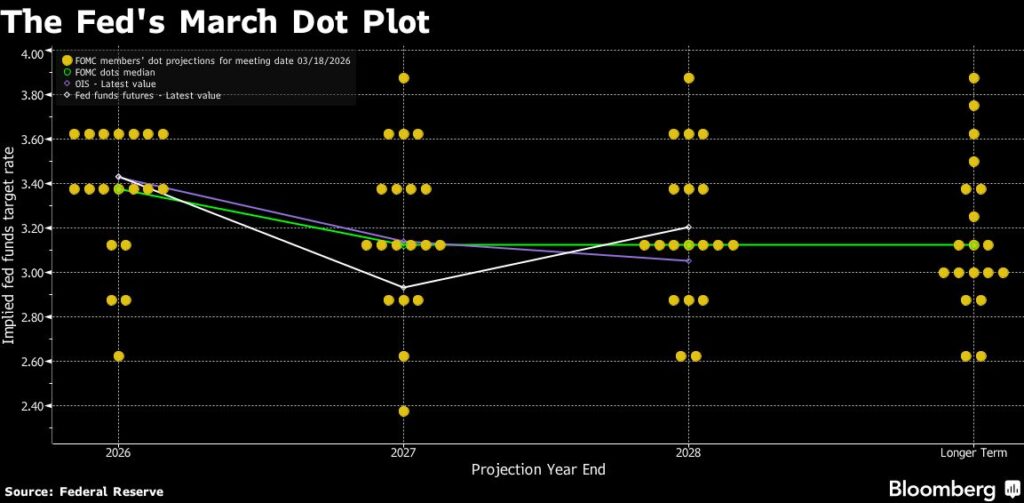
In the updated projections, officials continued to expect one quarter-point rate cut in 2026 and one in 2027. No policymakers indicated a preference to raise rates this year.
Policymakers slightly upgraded their outlook for growth in 2026 to 2.4%, from the 2.3% they forecast in December. Their unemployment forecast remained unchanged at 4.4% for the end of 2026.
Central bankers typically don’t raise rates when energy prices jump because the impact on inflation is temporary. But that approach hinges on the public continuing to expect inflation will settle around the Fed’s 2% goal over the long term. After five years of elevated inflation, some policymakers worry that expectations could creep up, though most survey and market-based measures remain in check.
DOJ Probe
Trump has nominated a former Fed governor, Kevin Warsh, to replace Powell. But a key Republican senator — who views the DOJ probe as politically motivated — has vowed to block Warsh’s confirmation so long as the investigation continues.
Last week, US District Chief Judge James Boasberg threw out DOJ subpoenas targeting Powell and the Fed, saying the government had advanced no evidence to justify them. But US Attorney Jeanine Pirro has vowed to appeal, leaving Warsh’s nomination in limbo.
By Maria Eloisa Capurro — (Bloomberg)