California has an electric big rig mandate, manufacturers will struggle to meet it
California’s goal is ensuring all new trucks sold in the state will be zero emissions by 2036

California became the first state in the US to set emissions standards for trucks earlier this year. The rules are set to kick in starting in 2024, putting pressure on truck manufacturers to speed mass production of electric trucks to meet the state’s ambitious goal.
The state has created a test market for electrifying freight transit, similar to what it did for passenger vehicles, that could radically change the $940 billion US trucking industry. But truck makers’ efforts will need to rapidly pick up speed to reach California’s goal of ensuring all new trucks sold in the state will be zero emissions by 2036.
“There are going to be a lot of challenges ahead for California, for manufacturers and the fleets,” said Margo Oge, an engineer and former director of the Environmental Protection Agency‘s Office of Radiation and Indoor Air. “But given the fact that we have over a decade to get to zero emissions and that these truck manufacturers are putting in the investments, my guess is that California is going to be successful.”
Though they initially fought the rules, the biggest truck makers in the US have promised to comply with the state’s first-in-the-nation mandate after striking a compromise with California regulators. Zero-emission truck upstarts like Tesla as well as traditional manufacturers have poured billions into zero-emission technologies and new high-volume factories in nearby states to jumpstart the budding industry.
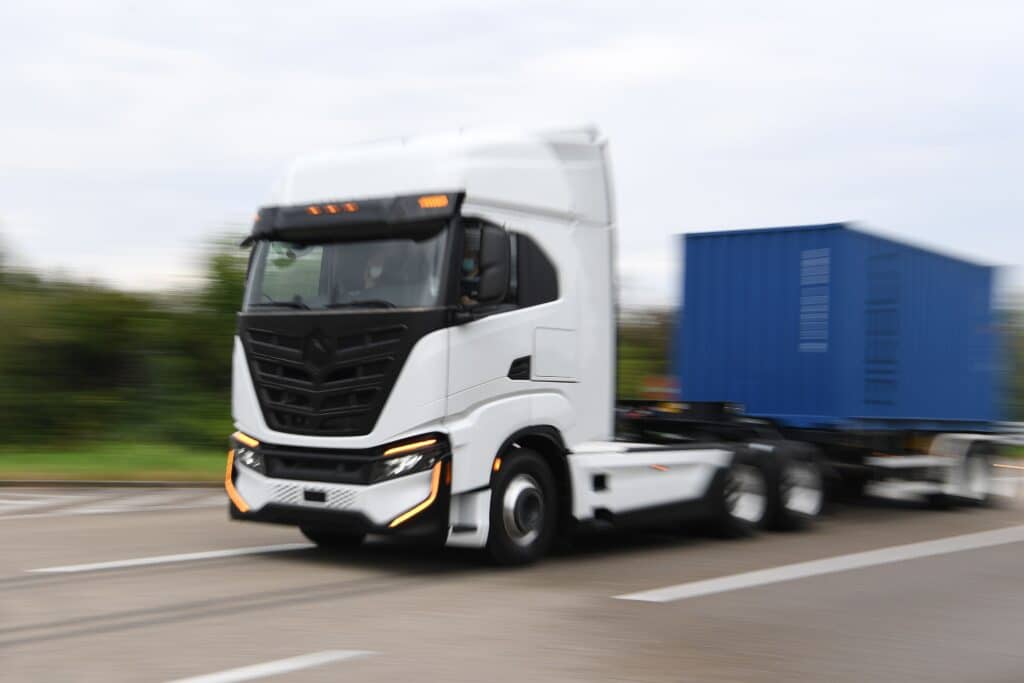
Cutting transportation emissions is vital to California meeting its 2045 carbon neutrality target given the sector is the largest source of planet-warming gases in the state. (Fossil-fueled transport also contributes to the disproportionate air pollution burden in low-income communities.)
“California really has taken the lead,” said Rakesh Aneja, truck maker Daimler’s head of e-mobility. “It has several of those puzzle pieces in play, which has made it the primary and first market that’s become very important to us.”
In the race to supply zero-emission big rigs, truck and engine manufacturers have already hit production delays brought on by supply chain constraints and safety recalls, raising questions about whether they can produce at the scale and price points necessary to meet the trucking industry’s needs. A 2022 battery electric semi model costs about $279,000 compared to the roughly $150,000 price tag of a new conventional diesel truck, according to the International Council on Clean Transportation.
The lack of a charging network is also delaying electric truck adoption. Fleet operators don’t want to buy zero-emission models today because there aren’t enough chargers; but without buyers, manufacturers can’t ramp up production, leading to higher costs. The regulation also faces a lawsuit arguing the state overstepped its authority that was filed on Monday by the California Trucking Association, an industry trade group. The suit asks for an injunction that would bar the state from implementing the rule.
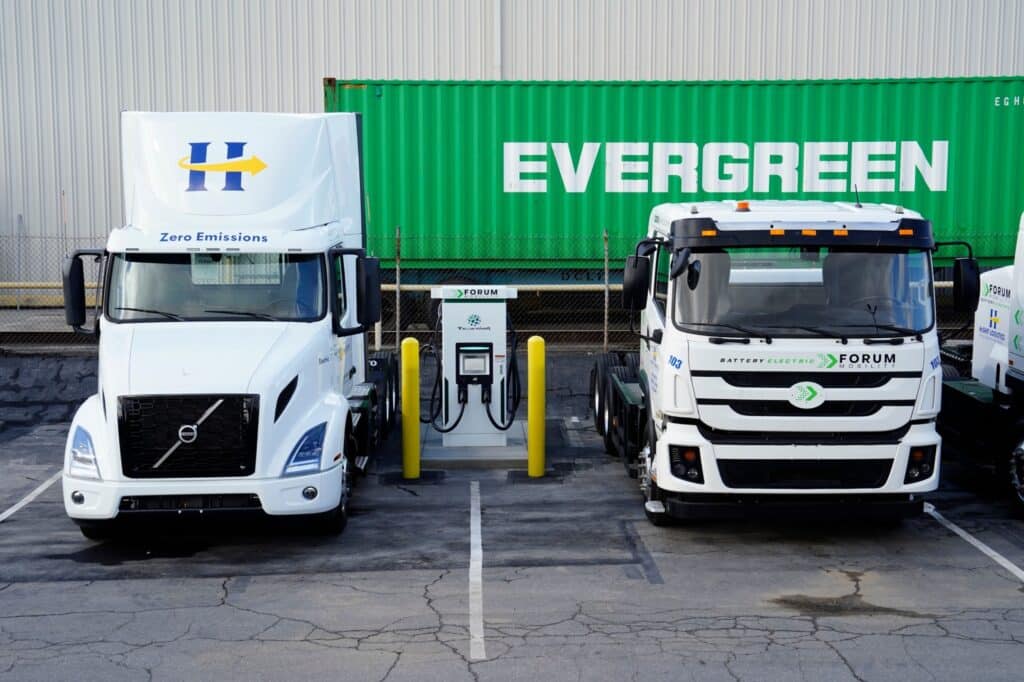
The mandate will lead to a widespread transformation of the commercial trucking industry, affecting about 1.8 million trucks on California’s roads. There are currently only 2,320 zero-emission medium- and heavy-duty vehicles on California’s roadways — but nearly all are buses. In addition to the 2036 ban on the new sale of gas- and diesel-powered trucks, large trucking companies must also convert their entire fleet to electric or hydrogen models by 2042.
Truck makers are spending big to speed the transition. Tesla has invested $3.6 billion to expand its northern Nevada factory, where it claims its 3,000 workers will start cranking out 50,000 Semis — its all-electric 18-wheeler that can go 500 miles on a single charge — a year by the end of 2024. Startup Nikola says it can expand its capacity to produce 20,000 electric trucks annually once its operations are at full capacity.
Legacy manufacturers have also gotten in on the act. Daimler has invested about $3.2 billion over the past several years to develop its electric models while Cummins — one of the world’s largest diesel engine manufacturers — announced in March the launch of Accelera, a new $1.5 billion venture to make the company’s hydrogen fuel cells and batteries for zero-emission trucks. Toyota is also turning to hydrogen fuel cells to produce a big rig for the North American market, including California, after receiving approval from state regulators in April.
Despite the billions that companies are throwing at manufacturing, they’ve largely failed to approach anything close to the scale of production needed. An uneven sales rollout could also erode truckers’ trust.
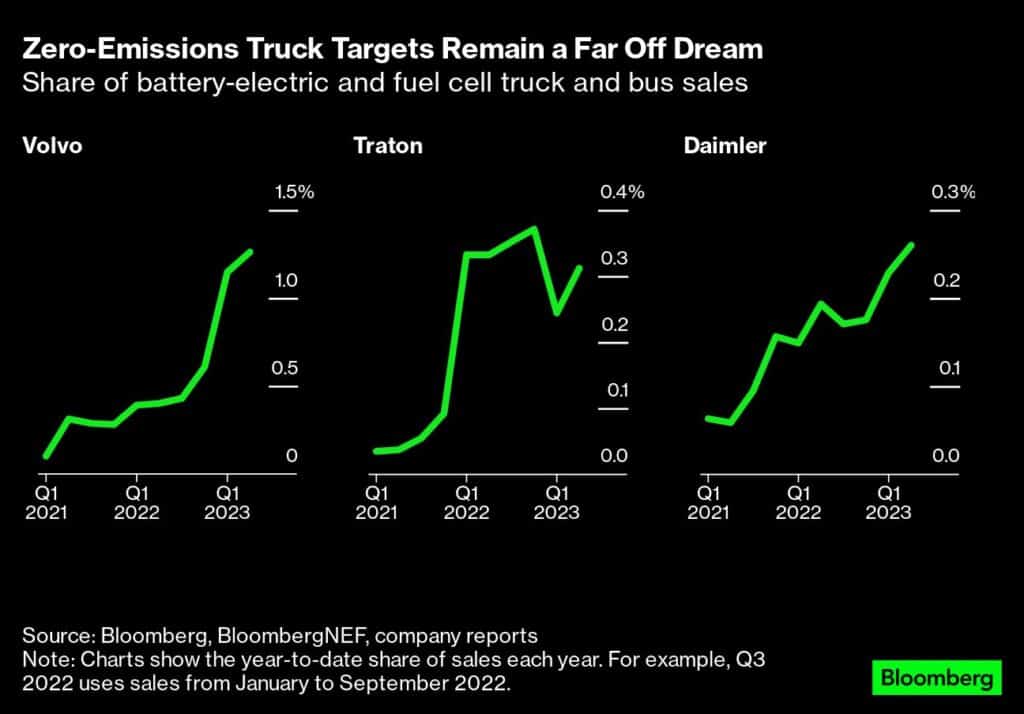
Daimler has been making electric vehicles since 2017, but it only sold about 1,000 zero-emission models in 2022. That’s a drop in the bucket compared to the 520,291 vehicles it deployed last year. The company expects more than half of its total truck sales to be zero-emission models by 2030 and plans to only sell carbon-neutral vehicles by 2039. The automaker said it is currently the US market leader for electric heavy-duty trucks based on vehicle registration data.
Tesla’s Semi was initially supposed to be released in 2019, but now the company says large-scale production won’t occur until the end of 2024. Safety recalls have also been an issue. Earlier this year, Tesla issued a recall for 36 semi trucks with a faulty door closure warning system, while Nikola recalled 364 trucks — the total manufactured since November 2021 in the US — due to the improper installation of a safety feature.
Daniel Sperling, director of the Institute of Transportation Studies at University of California, Davis, said the truck manufacturing industry’s confidence in increasing production is important because “it indicates that this transition to zero-emission trucks really is going to happen.” He remains skeptical, however, about the state reaching its goal.
“The 2036 target is going to be very, very difficult to meet,” said Sperling, who is also a former California Air Resources Board (CARB) member. “Frankly, I’d be surprised if it really is met.”
The recalls in particular have added to fleet operators’ concerns about purchasing zero-emission models, which are far more expensive than a diesel equivalent.

Electric trucks are expected to reach cost parity with their diesel counterparts around 2030, according to a BloombergNEF analysis. Those projections mirror CARB’s estimates, which conclude that over its lifespan, the total cost of ownership in 2035 for an electric semi could range between $765,000 and $1.1 million compared to a gas or diesel truck’s $919,000 to $1.2 million, excluding federal and state subsidies.
Daimler’s Aneja said manufacturers are ready to churn out the high volume of trucks needed, but demand from fleet operators remains low due to the scarcity of chargers.
“We are able to scale up and meet the needs of our customers and the market,” he said. “Unfortunately, what our customers aren’t able to find is the necessary infrastructure to support these vehicles.”
The state will need at least 157,000 medium- and heavy-duty chargers by 2030 to support fleet electrification, according to the California Energy Commission. Some truck companies could benefit from charging depots instead of placing chargers on their own sites. Startups like Forum Mobility are already starting to build charging networks. Truck manufacturers like Volvo are also investing in chargers.
Michael Lohscheller, former president and CEO of Nikola, said building reliable charging as manufacturers increase production is vital to successfully transitioning to electric trucks. Charging networks for electric models will drive massive growth in energy demand since trucks are much larger than electric cars and require vast amounts of power.
“Let’s get diesel trucks off the road,” he said. “The faster this happens, the better.”
— By Nadia Lopez (Bloomberg)


Proud Member Of

Check Out Our Industry Event