Deere orders rise despite farm cash constraints
Financial Services net income fell 21.2% YoY

Deere’s North American early orders have increased by double digits as farmers replace aging machinery despite tight margins and limited working capital.
The increase reflects replacement demand from an aging fleet, Dan Pooley, manager of investor communications, said during Deere’s fiscal fourth quarter earnings call today. Declining used equipment inventories, particularly for combines, also left dealers better positioned heading into fiscal 2027, which began Nov. 2, he said.
Deere forecasts U.S. and Canadian large agricultural equipment industry unit sales will increase 5% to 15% in fiscal 2027, Poole said. Elevated input costs and crop prices retreating from recent highs will likely moderate the recovery, he said.
Financial pressures divide buyers
Only 20% of farmers surveyed in October said it was a good time to invest in machinery and buildings, according to the Purdue University-CME Group Ag Economy Barometer’s Nov. 3 report. The survey included 400 farmers nationwide and was conducted Oct. 12–16.
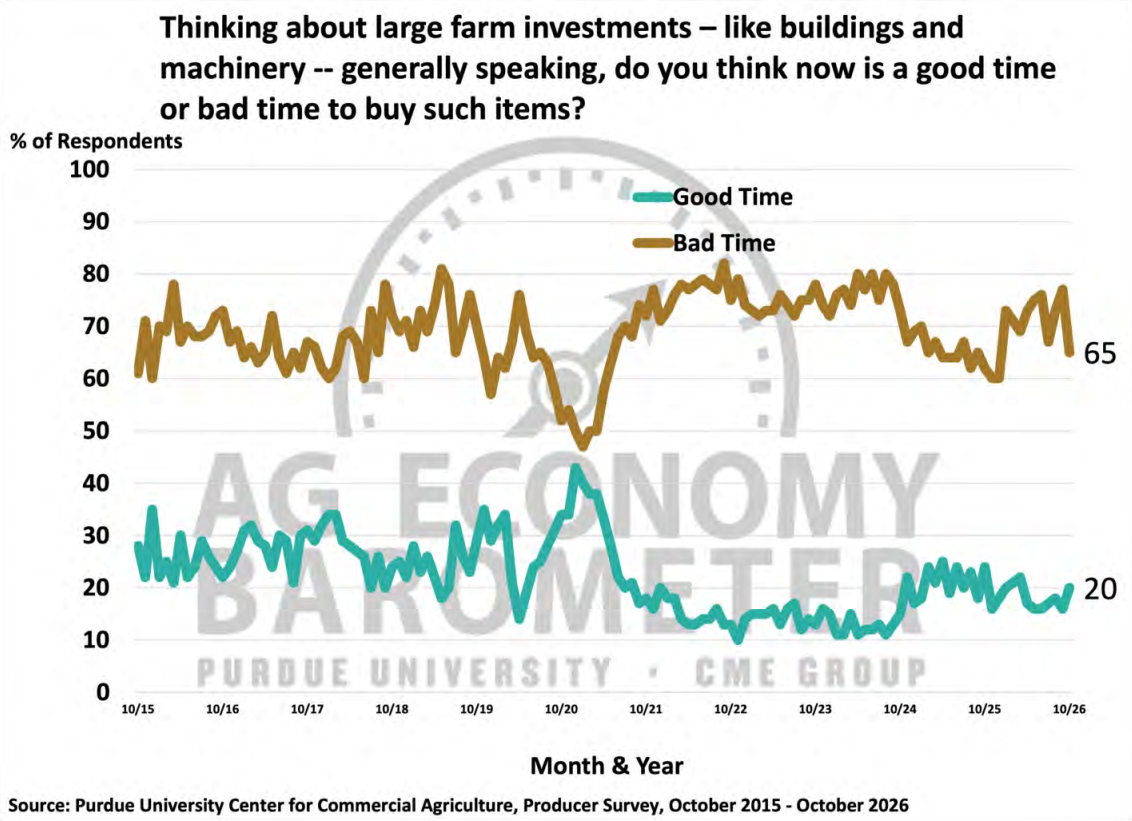
Government payments helped improve October sentiment, but weaker working capital remained a barrier for some producers, Purdue agricultural economist Michael Langemeier told Equipment Finance News.
Nine percent of respondents identified financial conditions as their biggest constraint, Langemeier said. He expressed concern about that group’s ability to resume capital spending.
“That doesn’t mean they’re going to go bankrupt, but that group is not going to be able to invest in anything for a long period of time.” — Purdue agricultural economist Michael Langemeier
Stable land values were supporting farm balance sheets, but producers with capacity to invest still faced difficult decisions about when to replace machinery, Langemeier said.
Meanwhile, in the Ninth Federal Reserve District, which includes the states of Minnesota, Montana, North Dakota, South Dakota, as well as the Upper Peninsula of Michigan, and northwestern Wisconsin, 54% of agricultural lenders surveyed reported lower farm capital spending in the third quarter compared with a year earlier, according to the Minneapolis Fed’s third-quarter Ag Credit Survey, released Nov. 11.
Increased agricultural borrowing largely reflected higher operating expenses and reduced working capital, Joe Mahon, director of regional outreach at the Minneapolis Fed, said during a Nov. 13 webinar.
“Producers are telling me that there’s a lot of uncertainty about the long-term environment,” Mahon said.
Deere by the numbers
Deere reported the following results for its fiscal fourth quarter, which ended Nov. 1:
- Production and precision agriculture sales landed at $4 billion, down 15.2% year over year;
- Small agriculture and turf sales totaled $2.7 billion, up 10% YoY;
- Construction and forestry sales reached $3.8 billion, up 12.2% YoY;
- Financial services net income was $231 million, down 21.2% YoY; and
- Full-year equipment operations net sales increased to $41.3 billion, up 6.1% YoY.
Lower shipment volumes drove the decline in production and precision agriculture sales, while financial services earnings fell due to unfavorable financing spreads, a lower average portfolio and a higher credit-loss provision, Pooley said during the call.
The strength of remaining North American orders will help determine the pace of recovery, Chairman and Chief Executive John May said during the call.
“An aged fleet and limited field inventories for new equipment are driving required replacement demand, even as farm economics remain tight,” he said.
Shares of Deere & Co. [Nasdaq: DE] were trading at $641.02 at market close today, up 4.4% or $27.26 from market open. Deere has a market capitalization of $172.8 billion.
Check out our exclusive industry data here
This article has been updated to reflect the end of day stock information.