Truckers who fail English tests get pulled off roads in Trump crackdown
Up to 400K drivers could exit market in coming years

Truck drivers are encountering a new risk on the highway: Law enforcement officers are empowered by the Trump administration to pull them off the road if they fail an English test.
The government argues the rules are critical to safety. For Vadym Shpak, they’re a costly and frustrating disruption.
Shpak, the owner of an Illinois-based trucking company, has had to book planes and car rentals for drivers who’ve had to abandon their rigs while on the road. Some of his employees, who are mostly Eastern European, refuse to go to southern states for fear of being targeted. He says his insurance premiums are climbing because of an increased number of violations.
“These are good drivers, experienced drivers, but they get pulled over and the officer says their English isn’t good enough,” he said. “And you know what happens? I have to pay for everything.”
The language crackdown is part of a broader Trump administration campaign that’s upending the trucking industry, a critical pillar of the US economy. In September, Transportation Secretary Sean Duffy sought to sharply limit commercial driver’s licenses for foreign-born applicants, a move since paused by a federal court. In recent months, hundreds of truckers have been swept up in Immigration and Customs Enforcement raids across Oklahoma, Texas, Indiana and New York.
What began as a push for highway safety has expanded into a far-reaching enforcement drive that immigrant advocates say indiscriminately targets foreign-born truckers who are legally permitted to be in the country. The Department of Transportation, tasked with ensuring safety and efficiency, has become a part of Trump’s broader immigration agenda — deepening uncertainty in an industry already mired in a slowdown marked by sluggish demand and low freight rates.
“There have been reports of areas where drivers are unwilling to go, and it generally is going to correspond to wherever ICE recently was,” said Aaron Graft, chief executive officer of Triumph Financial Inc., a banking platform for the freight industry. For days afterwards, trucking rates in those areas increase as the supply of drivers goes down, he said.
The trucking industry, which initially brushed off the possibility of major impacts, is now preparing for a sharp drop in the number of drivers. Shelley Simpson, CEO of freight shipping company JB Hunt Transport Services Inc., said at a recent conference that she’s expecting as many as 400,000 drivers — about 11% of the supply — to leave the business over the next few years because of enforcement actions, a number she has called “meaningful.”
Commercial truckers face stricter language requirements than regular drivers because their jobs require frequent communication and decision-making as they operate massive vehicles. Trucking experts agree that it’s critical for drivers to be able to interact and read road signs, with rules on language proficiency dating back decades. But since the Obama administration, violations typically only resulted in citations. That changed after an April executive order from President Donald Trump calling for “commonsense rules of the road” to be applied to US truckers.
Within weeks, the DOT issued new guidance prompting inspectors to place drivers out of service who didn’t speak sufficient English. “Federal law is clear, a driver who cannot sufficiently read or speak English — our national language — and understand road signs is unqualified to drive a commercial motor vehicle in America,” Duffy said in a press release.
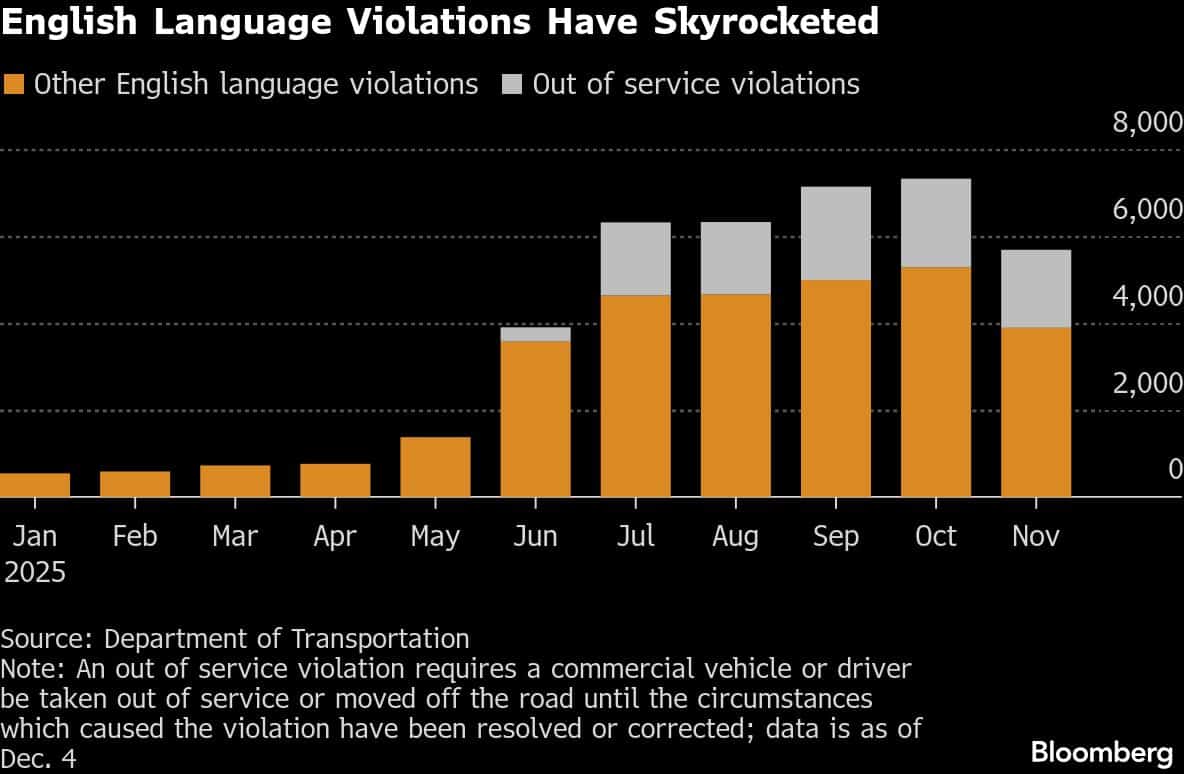
Since the policy went into effect in late June, violations have spiked — and there have been more than 9,500 cases of drivers being pulled off the road, according to a Bloomberg News analysis of federal data. Texas and Wyoming led the way in enforcement. Drivers in specific commercial zones near the US border are exempt from out-of-service orders, but they may still receive citations.
The issue has become increasingly politicized: In August, immigrant trucker Harjinder Singh allegedly tried to make an illegal U-turn onto a southbound lane on the Florida Turnpike. While the trailer was crossing lanes to make the turn, a minivan heading north smashed into it, killing three people. The crash immediately became a flashpoint for the administration, with the Department of Homeland Security saying Singh had entered the country illegally before obtaining a California-issued commercial driver’s license. He has pleaded not guilty to charges of manslaughter and vehicular homicide.
Secretary of State Marco Rubio announced the suspension of worker visas for foreign truckers, warning that the increasing number of foreign drivers was “endangering American lives” and undercutting the livelihoods of US-born truckers. Weeks later, Duffy’s agency issued an emergency rule restricting who was eligible for a “non-domiciled” commercial driver’s license — referring to drivers who are neither US citizens nor lawful permanent residents — based on immigration status.
The rule barred asylees, DACA recipients and refugees from renewing or upgrading their licenses, even if they’d driven legally and safely in the US for years. States that didn’t comply would see a loss of federal funding, with California at the top of the list. Duffy has since announced that California is moving to revoke 17,000 of the licenses already issued. His department also has said it would withhold at least $40 million in funding over the state’s failure to enforce language requirements.
“There has been tremendous confusion, anxiety, fear among many drivers,” said Josh Rosenthal, a workers’ rights attorney at the Asian Law Caucus, a civil-rights organization serving Asian American and Pacific Islander communities. That’s led to a climate of fear and “uncertainty that’s unnecessary and is getting in the way of the actual business of transporting goods,” he said.
When asked for comment, a spokesperson for the Transportation Department referred to Duffy’s press releases and a social-media post, including one from November in which he vowed to challenge the ruling that paused the restrictions on commercial driver’s licenses. “We won’t stop fighting to keep dangerous, unqualified truck drivers off the road,” Duffy said.
Iconic Job
There are an estimated 3.5 million truck drivers in the US. As the population voraciously consumes more goods, materials, food and energy, trucks keep those items moving like blood through veins.
Trucking jobs were once a gritty slice of Americana. Drivers of the 1970s were cast as modern-day cowboys, growling into CB radios and backed by powerful unions. The career was big in pop culture, too: In 1976, C.W. McCall’s truckers’ anthem “Convoy” topped the charts with its call to “roll this truckin’ convoy ’cross the USA.”
“Part of the fascination with it is, you see them driving down the road with whatever and it represents the economy of the US, right?” said Kristen Monaco, an economist who studies the trucking market. “It represents capitalism.”
Indeed, trucking’s centrality to the American economy and culture explains the Trump administration’s focus on the industry in the first place. Under Trump, the government has been more active with the industry than any administration since Jimmy Carter’s, said Gregory Reed, a transportation attorney at law firm Hanson Bridgett. “There is no more sort of iconic blue-collar job — other than potentially working in agriculture — than being a truck driver,” Reed said.
Trump won the presidency twice by appealing to working-class White Americans who felt left behind in a shifting economy. He centered much of his message on an immigration wave that pushed up the share of foreign-born individuals in the US to the highest since the early 20th century.
The trucking industry is no exception to that trend. The share of drivers born in the US dropped from 85% to 80% between 2009 and 2023, according to an analysis Monaco conducted of American Community Survey data.
Beneath the swaggering Wild West persona of trucking lore, driving can be a grueling job. Long-haulers spend weeks away from home, often parking on off-ramps to get some sleep. Many struggle with health problems tied to inactivity and poor food options, while wages are no longer as competitive as they once were. In 2022, the average trucker earned less than half what he did in the 1980s, adjusted for inflation, according to the National Transportation Institute.
Thaw, a 46-year-old asylum seeker, found a measure of freedom on America’s open roads after fleeing Myanmar’s military rule. Leaving behind violent government forces bent on wiping out certain ethnic groups, he became a long-haul truck driver for C.R. England, earning around $1,500 a week.
“I love to travel around so many different places,” said Thaw, who asked to go by his first name because of his immigration status. “That job is very cool.”
Thaw is searching for a job closer to his home in the San Francisco Bay area, in hopes he can bring his wife and two sons to the US once his asylum case is settled — which may take even longer now that the administration has stopped processing claims. So far, finding a commercial driving job has been an exercise in false hope. He was on track to become a bus driver and even showed up on the first day of orientation, when a recruiter called to tell him he couldn’t move forward.
In the aftermath of Duffy’s rule on non-domiciled commercial licenses, the California Department of Motor Vehicles declined to upgrade Thaw’s license with the necessary endorsement to carry passengers, even after his application had been approved. “I feel really upset,” he said. “This is not my mistake.”
He’s now driving for Uber while he looks for another job.
Policy Confusion
Motor carriers, advocates and truckers have said the language policies are confusing and impossible to prepare for, while also allowing officers to profile truckers. At the center of the controversy is a long-running debate over the link between language ability and road safety.
The Commercial Vehicle Safety Alliance removed limited-English ability as an “out-of-service” factor in 2015 after finding no evidence it created an imminent crash risk. Advocates say the new policy reverses that logic without evidence. It also gives officers broad discretion.
“What they’re told is essentially, ‘you know it when you hear it,’” said Rosenthal with the Asian Law Caucus. “It invites bias on the basis of accents, even for somebody who is perfectly able to understand and communicate in English. Bias in terms of who’s even being evaluated for English language proficiency in the first place.”
The roadside stops can be lopsided, says Munmeeth Kaur, legal director at the Sikh Coalition, a civil rights group involved in tracking the crackdown because about one-fifth of the Sikh population in the US is in the trucking industry.
“It has kind of allowed for a sort of zealous pursuit by officers of all stripes to engage in this kind of inspection,” Kaur said. “These interviews are not recorded. You could only imagine the imbalance that this creates.”
In the case of non-domiciled drivers, the link between roadway safety and immigration status also is dubious. Opponents point out that the Federal Motor Carrier Safety Administration’s own rule states that there isn’t sufficient evidence to show an empirical relationship between a driver’s national identity and safety outcomes.
For now, immigrant drivers from many states are in limbo. Although a federal court temporarily paused Duffy’s rule restricting commercial driver’s licenses to certain groups, many states have put them on hold anyway while they wait for clarity.
Javier Gomez hauls fresh produce and other ingredients to Bay Area restaurants as a driver for US Foods, one of the largest food distributors in the US. At 24, he’s able to pay rent for the house he shares with his girlfriend, who is a full-time nursing student, and her school tuition. Gomez, who immigrated to the US from Mexico before he was six years old, has been authorized to work — and eventually get his commercial driver’s license — through DACA, since he was a teen.
Gomez predicts he won’t be able to renew his license next year. He’s thinking about backup careers, although he loves driving – maybe construction. He’s seen friends and colleagues have their licenses revoked in recent weeks.
“It’s in a matter of seconds that your life can change,” he said.


Proud Member Of

Check Out Our Industry Event