Experts weigh in on distress, bankruptcies in trucking
Operating costs in trucking soared 37.3% over past four years

From tightened lending standards to geopolitical uncertainty, a myriad of factors are prolonging the freight industry’s recession and triggering financial stress.
More than 30 trucking companies have filed for Chapter 11 bankruptcy since the start of the second quarter, according to documents obtained by Equipment Finance News. Nearly 7,500 carriers exited the market in April, marking a 12-month high, according to logistics and supply chain management services provider ITS Logistics.
Even some experienced carriers, such as Groveland, Fla.-based Carroll Fulmer Logistics, which ceased operations on July 29, have been unable to survive the yearslong freight recession, a troubling sign for the industry, Dean Croke, principal analyst at DAT Freight and Analytics, an information services and technology provider, told EFN.
“I think the canary in the coal mine is when you see 71-year-old truckload carriers like Carroll Fulmer decide to close up shop because it’s no longer economically viable. That to me is a real tell, because that’s a conscious decision to say, ‘We can’t make money in this industry anymore. It’s not worth the risk.’”
— Dean Croke, DAT Freight and Analytics
The squeeze tightens
The average operating cost for trucking companies was $2.26 per mile in 2024, up 37.3% since the start of 2020, reaching a record high of $2.27 in 2023, according to the American Transportation Research Institute.
Increased operating costs have coincided with an extended period of low spot rates, with the average dry van linehaul rate landing at $1.65 per mile as of Aug. 10, down roughly 31% from four years prior when the pandemic trucking boom was in full swing, according to DAT Freight and Analytics data shared with EFN.
Many fleet operators are taking aggressive cost-cutting measures and reducing fleet sizes as margins continue to get squeezed, Croke said.
“I think most carriers realize they can’t get top-line revenue growth through rate increases. Their margins will come from aggressive cost-cutting and better equipment utilization and trading down, getting rid of surplus equipment.”
— Dean Croke, DAT Freight and Analytics
This trend is expected to continue for another six to nine months, he added.
Tariff uncertainty has exacerbated the strain on small fleets and owner-operators as shippers delay capital investments, Croke said.
“I think people are doing the bare minimum to get by, and that means there’s no growth in terms of the amount of freight that goes on the back of trucks,” he said.
The financing conundrum
Tightened credit standards are also contributing to the industry downturn, with more equipment lenders requiring larger down payments, raising interest rates or pulling back from the transportation sector altogether.
Hesitancy to finance trucks shows that many lenders “really took a beating in 2024 in terms of repossessions that they then had to auction off,” Jarrett Harris, director of research at heavy-equipment research firm IronAdvisor Insights, told EFN.
“Some saw massive losses on those [repossessed trucks], and they’re not anxious to repeat that, which is understandable,” he said. “So, they’re deferring, trying to extend terms to some of their existing customers.”
Despite the strong urge to resist, lender repossessions would help address persisting overcapacity, improve freight rates and accelerate the market’s natural correction, Harris said.
DAT’s Croke similarly said that many lenders are allowing carriers to operate for longer durations as they struggle to break even.
Why Chicago?
About 33% of the freight companies that have gone bankrupt since the start of Q2 filed in the Northern District of Illinois.
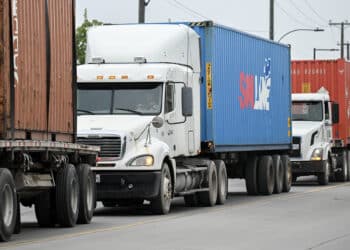
While it’s unclear why, it’s possible that this concentration of Chapter 11 filings can be attributed to highly compressed margins in the drayage truck market, Croke said. Drayage trucks are short-haul Class 8 vehicles used to transport goods between ports, railyards and terminals.
“You talk about Chicago, all of the Class 1 railroads are there,” he said. “Every container that comes in from the West Coast has to get rubber tied across town between train lines. So, drayage in Chicago, it’s a real melting pot of cultures.”
Check out our exclusive industry data here.



Proud Member Of

Check Out Our Industry Event