Chinese EV OEM Windrose eyes collaborations for charging
Maker set goal of 2,000 truck deliveries in 2026

Chinese electric truck manufacturer Windrose Technology aims to expand its global presence through collaborations with charging companies, alongside existing logistics partnerships.
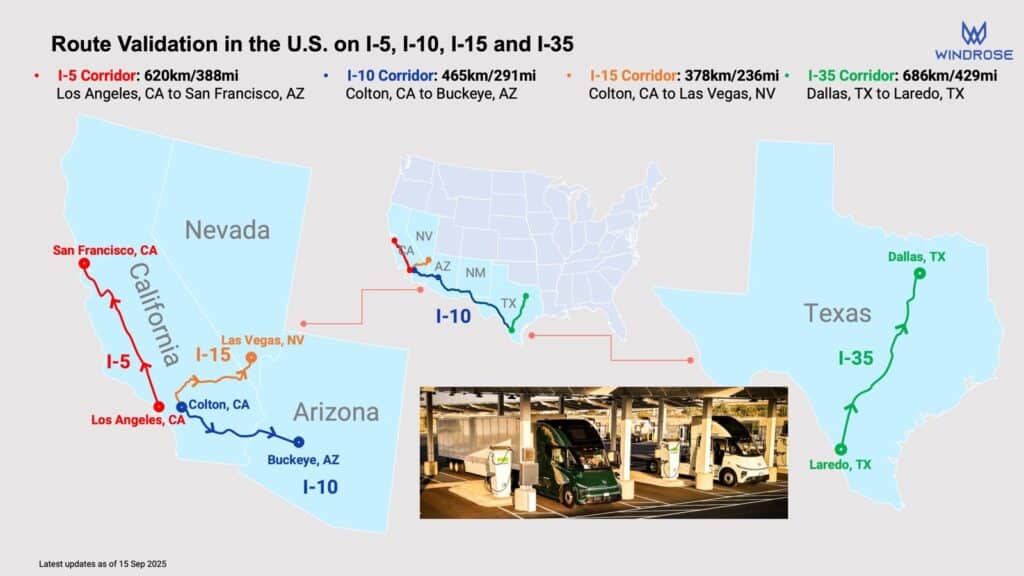
As part of Windrose’s growth strategy, the company updated its United States zero-emissions trucking map showing Class 8 R700 battery-electric semi routes across major interstate corridors in Arizona, California, Nevada and Texas, according to a Dec. 29. 2025, LinkedIn post by founder and chief executive Wen Han.
The company plans to expand its charging collaborations “to help reduce (or eliminate) the cost of EV truck charging to help customers get started,” Han said.
The map underscores the OEM’s focus on the Southwest as it advances U.S. production, charging partnerships and broader expansion plans.
Financing EV trucks requires understanding and often additional support as many large credit customers pursue the ev truck sales mainly as green marketing initiatives, David Normandin, president and CEO of Wintrust Specialty Finance, previously told Equipment Finance News.
Partnering for growth
Windrose Technology launched the first all-electric long-haul sleeper truck in the U.S. in April 2025 by partnering with JoyRide Logistics and EO Charging, according to a Windrose release. The companies deployed a 420-mile-range Class 8 EV truck traveling across key sectors in Arizona, California and Nevada to improve the total cost of ownership.
The trucks, which feature fast charging capability, more than 700 kWh of battery capacity and proven real-world testing, mark a commercial-ready step toward scalable zero-emission long-haul freight, the release stated, with nationwide expansion planned.
Through a partnership with charging manufacturer Greenlane Infrastructure, Windrose completed a commercial EV charging corridor along Interstate 10 between Southern California and Phoenix in August. It plans to manufacture 2,000 electric trucks in 2026. Electric carrier Nevoya also uses Windrose trucks and Greenlane’s infrastructure for pilot programs on the I-10 and I-15 corridors, marking a key step toward scalable, zero-emission freight operations.
Check out our exclusive industry data here.