AI paves way for equipment lenders to predict residual values
Predictive AI market could surpass $88B by 2032

AI advancements are enabling lenders to better predict residual values, a boon for the equipment finance industry as machines become increasingly tech heavy.
The global market for AI in financial services is expected to grow 34.3% annually to $249.5 billion in 2032 from 2025, according to Verified Market Research. The global predictive AI market is projected to hit $88.6 billion by 2032, a more than fourfold increase from 2025, according to research firm Market.us.
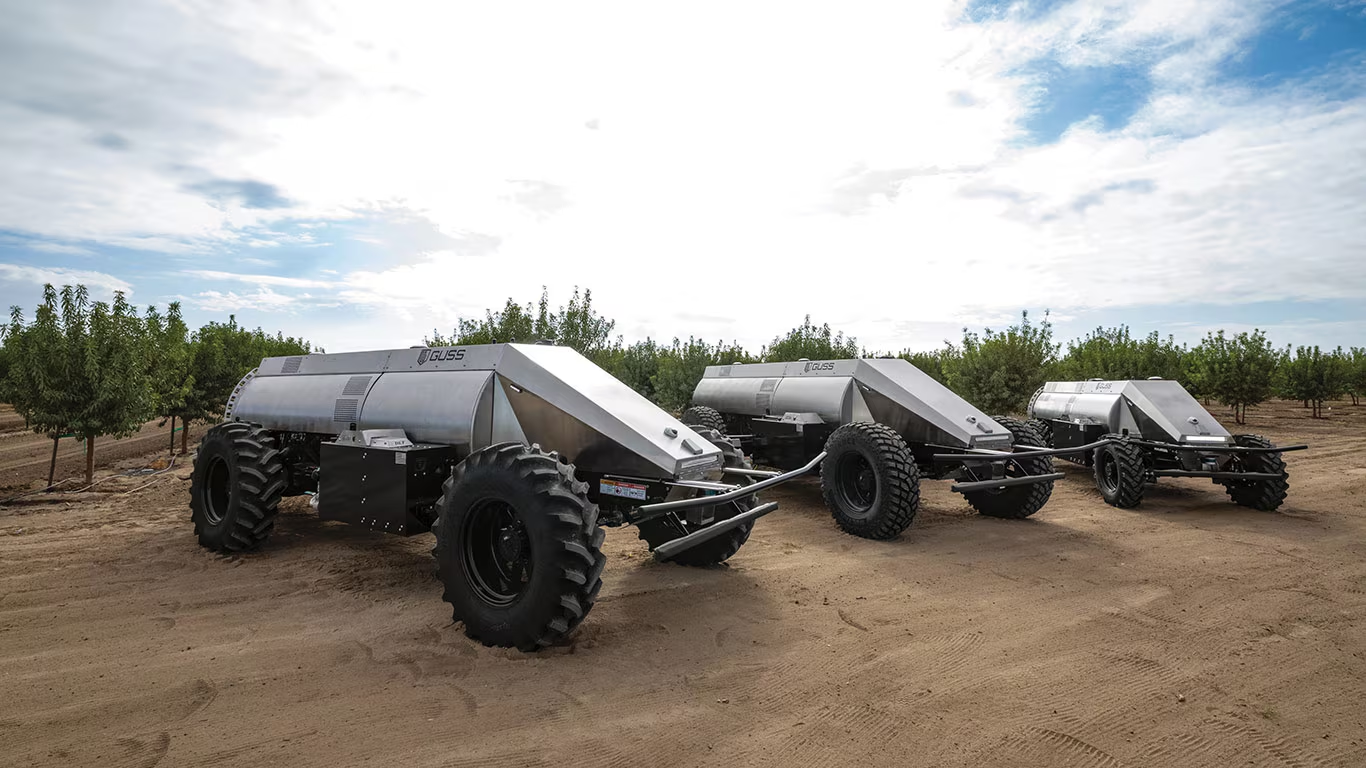
The potential benefits of AI for predicting residuals are especially relevant for equipment lenders as autonomous solutions, telematics systems, GPS systems and other machine technologies enter the market. Lenders have been reluctant to finance new tech-heavy machines due to residual-value uncertainty. The uncertainty is driven by:
- Limited historical performance data;
- Rapid obsolescence; and
- Lack of a resale market.
Nearest neighbor
Fintechs and lenders can overcome these hurdles by deploying the “nearest-neighbor technique” with machine learning, Timothy Appleget, director of technology services at Tamarack Technology, an AI and data solutions provider, told Equipment Finance News.
The nearest-neighbor method uses proximity to make predictions or classifications about the grouping of an individual data point, according to IBM. The technique helps “fill gaps in data that don’t exist,” Appleget said.
For example, rather than just gathering scarce residual-value data for autonomous equipment, lenders and fintechs should seek data for the technologies enabling them — or other asset types with similar systems.
Data integrity is crucial during this process, Tamarack President Scott Nelson told EFN.
“If I can find an asset type that’s inside the definition of this more techy thing, then that’s like a nearest neighbor,” he said.
Borrower behavior
Borrower behavior is also an important factor to consider when developing AI tools for predicting residuals, Nelson said.
“One of the biggest effects on residuals is usage,” he said. “So, an interesting question would be: Is anybody out there trying to aggregate data about the operators to predict the behavior of the people moving this equipment around?”
— Scott Nelson, president, Tamarack Technology
To achieve this, fintech-lender partners can take advantage of the data collection and transmission capabilities of emerging equipment technologies, such as telematics, Nelson said. Even simple tech, like shock and vibration sensors, can aid this process, he said.
“You get two things immediately: You get runtime, because anytime the thing is vibrating, it’s running,” he said. “If you’ve got runtime, you’ve got hours on the engine, which is one of the big factors. The shock sensors tell you whether or not it got into an accident or whether or not it was abused. That runtime data can also be converted into revenue generation. How often is this thing generating revenue?”
Integrating operator-behavior data with predictive AI could help lenders gain a competitive edge because many take a conservative approach when financing relatively new assets, Appleget said.
“This additional asset-behavioral data, to me, opens up the potential for having more flexibility in the residual values you set for a specific asset,” he said. “If you have that level of sophistication, you can gain a considerable advantage.”
Check out our exclusive industry data here.