Bank-private credit partnerships reshape equipment finance
Annualized net losses dropped 17 bps MoM

Banks are increasingly partnering with independent lenders and private credit firms to preserve client relationships while easing balance-sheet pressure, accelerating a structural shift across the equipment finance market.
The trend is reshaping how banks and independent lenders approach equipment finance, asset-based lending and commercial finance as regulatory pressure and capital efficiency concerns continue to mount, Corinne Seton, senior vice president and head of capital markets at Mitsubishi HC Capital America, told Equipment Finance News.
“It started off as cyclical, but over time, it’s become structural,” she said.
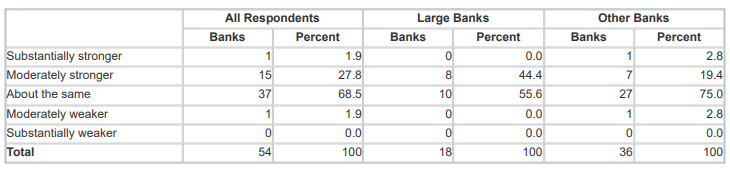
Demand for bank loans to private equity funds also increased “significant net shares,” according to the Federal Reserve’s April Senior Loan Officer Opinion Survey on Bank Lending Practices, published May 4. Sixteen of the 54 banks surveyed stated they saw stronger demand from private equity funds.
Demand from private equity funds
Private credit has grown into a roughly $2 trillion global asset class that now finances more than 80% of middle-market sponsored deals, dropping banks out of the picture as firms expand into asset-based finance, real estate and infrastructure lending, according to a Dec. 11 McKinsey report.
Market conditions
Higher interest rates, increased competition for deposits and ongoing economic uncertainty have pressured banks’ return on equity and tightened credit appetite, while Basel III and IV capital and liquidity requirements implemented after the 2008 Financial Crisis also reduced the attractiveness of smaller-ticket and asset-based lending on a risk-adjusted basis, Seton said.
“A $1 million loan often requires basically the same underwriting and monitoring and compliance as a $20 million loan without offering the same economics.” — Corinne Seton, senior vice president and head of capital markets at Mitsubishi HC Capital America
Meanwhile, equipment finance industry annualized net losses declined 17 basis points (bps) month over month and 7 bps year over year to 1%, while 60-plus-day delinquencies landed at 1.67%, up 1 bps MoM and 20 bps YoY, according to KBRA’s U.S. Equipment Loan and Lease ABS Indices for April, released on May 1. The index tracks 121 securitized equipment loan and lease pools totaling $37 billion in collateral balances.
Private credit drives partnership growth
Additionally, the rise of private credit is transforming asset-based lending from niche financing into a mainstream commercial finance strategy, Gordon Brothers executives Kyle Shonak, chief transaction officer, and Mark Bohntinsky, global head of credit, said in written responses to questions from EFN.
The transformation was “driven by the need to offer creative and flexible solutions for clients,” they said.
Since the start of 2025, several partnerships have formed, including:
- First Citizens Bank and Sixth Street in February 2025;
- JPMorgan Chase and Apollo Global Management in May 2025;
- Goldman Sachs and Apollo Global Management in May 2025;
- BlackRock and HPS Investment Partners closed in July 2025; and
- Gordon Brothers and Davidson Kempner Capital Management in Sept. 2025
Partnerships between banks and independent finance providers also enable banks to preserve treasury management services and customer relationships while reducing regulatory capital exposure, Mitsubishi’s Seton said.
“The banks want capital efficiency, favorable regulatory treatment and continuity with their customers, while independents and investors are looking for yield, downside protection and transparency,” she said. “Well-structured equipment finance transactions can satisfy both sides because the deals can be divided into senior and subordinated tranches, supported by conservative advance rates and strong servicing.”
Assessing risk amid growth
Competition has intensified as more firms enter the private credit and asset-based lending markets, but underwriting discipline remains critical, Gordon Brothers’ Shonak and Bohntinsky said.
“Like with any market with a rapid influx of new participants, there can be the risk of loosening standards,” they said. “It’s important to rely on firms that offer comprehensive strategies that assess risk holistically and emphasize rigorous loan structures and monitoring.”
Ultimately, the convergence between banks and private credit firms is expected to continue long term as independent lenders increasingly bridge the gap between capital- and regulatory-constrained banks and “capital-hungry” small-business borrowers, Seton said.
The fourth annual Equipment Finance Connect at the C. Baldwin in Houston May 18-19 is the only event that brings together the equipment industry to share insights, attend discussions on crucial industry topics and network with peers. Learn more about the event and register here.




Proud Member Of

Check Out Our Industry Event